Skip to product information
1 of 1

Dr Forest

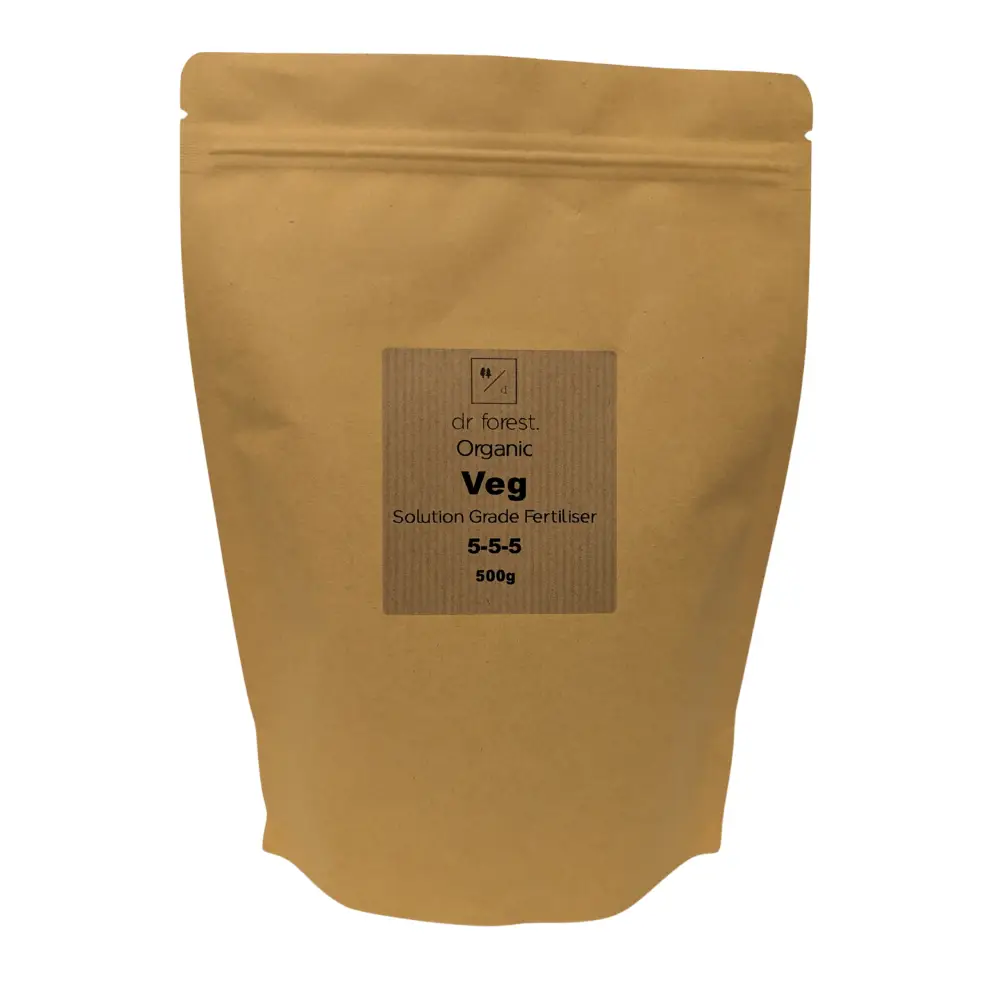
Organic Veg Booster UK | 5-5-5 NPK | Solution Grade

Organic Veg Booster UK | 5-5-5 NPK | Solution Grade

Regular price £18.50 GBP
Regular price Sale price £18.50 GBP
Sale Sold out
Shipping calculated at checkout.
Size
Quantity

Organic Veg Booster 5-5-5 — solution grade fast-release fertiliser for vegetables, plants & gardens

NPK 5-5-5 Solution Grade Fast Release Calcium & Magnesium Organic Certified Just Add Water

Most organic fertilisers are slow-release. They break down gradually in soil over weeks or months, which is exactly what you want for steady background feeding. But there are moments when plants need nutrients now — when a young transplant needs a kick-start, when a container plant is running low between granular top-dressings, when a crop looks pale and sluggish mid-season, or when you need to extend hang time in small pots. That is what Veg Booster is for.

This is a solution grade organic fertiliser — a concentrated powder that you add directly to water to create a nutrient-rich drench. It is not a liquid fertiliser in a bottle (you are not paying to ship tap water around the country). It is not a granular that sits on the soil surface waiting for microbial breakdown. The nitrogen and just under half of the potassium are fully water-soluble, delivering nutrients into the root zone within hours of application. The phosphorus and remaining potassium are micronised to ultra-fine particle size, ensuring rapid breakdown and absorption even though they are not technically soluble.

The formulation goes beyond NPK. Veg Booster contains amino acids enriched with humic and fulvic acid for enhanced nutrient uptake, soluble seaweed extract providing growth hormones and trace minerals, and micronised gypsum and magnesium mineral to keep calcium and magnesium balanced while you boost growth. The result is a fast-acting, balanced, mineral-complete organic feed that delivers all the speed of a synthetic liquid with none of the downsides.

5-5-5Balanced NPK
Ca + MgMineral Balanced
SolubleN & K Fraction
MicronisedP & K Fraction

What Veg Booster is used for in the garden

  • Fast-acting feed for vegetables and salad crops — when tomatoes, peppers, courgettes, beans, lettuce, spinach, kale, or any vegetable needs a rapid nutrient boost during the growing season; the soluble nitrogen fraction is available to roots within hours
  • Boosting sluggish or pale plants — when a plant has stalled, yellowed, or looks lacklustre mid-season; a single drench of Veg Booster often produces visible improvement within days
  • Extending container and small-pot performance — plants in small containers exhaust their nutrient supply quickly; Veg Booster extends productive life without waiting weeks for granular feeds to break down
  • Transplant establishment drench — a dilute drench at transplanting gives seedlings and young plants an immediate nutrient supply while their roots establish and begin accessing granular feeds in the soil
  • Between granular top-dressings — use as a liquid boost between regular slow-release granular applications; fills the gap when the previous top-dressing is running low and the next is not yet due
  • Houseplant and indoor plant feed — the solution format is ideal for houseplants, conservatory plants, and indoor edibles where granular top-dressings can look unsightly or attract fungus gnats
  • Lawn rescue drench — a fast-acting liquid feed for lawns that need rapid green-up after stress, drought recovery, or patchy areas; apply with a watering can for targeted treatment
  • Seedling and young plant feed — at the lower rate, provides gentle balanced nutrition for seedlings, cuttings, and young plants that are too small for full-strength granular feeds

Why solution grade rather than bottled liquid fertiliser?

Veg Booster — Solution Grade Powder

  • Concentrated powder — you add the water at home; no paying to ship water across the country
  • Far less plastic packaging per dose delivered than any bottled liquid
  • Nitrogen and potassium are fully water-soluble for immediate uptake
  • Phosphorus and remaining potassium are micronised for rapid breakdown
  • Includes amino acids, humic and fulvic acid, seaweed, calcium, and magnesium
  • Longer shelf life than liquid — store dry and mix fresh for each application
  • Lower carbon footprint per application than any bottled product

Bottled Liquid Fertilisers

  • Typically 85–95% water by weight — you are paying to ship tap water
  • Heavy plastic bottles generate significant packaging waste per dose
  • Convenient but far less concentrated per gram of active nutrients
  • Shorter shelf life once opened — some require refrigeration
  • Often contain preservatives to prevent microbial growth in the bottle
  • Higher carbon footprint from transport weight per dose delivered
  • More expensive per unit of actual nutrition delivered

The science of fast-release organic nutrition: soluble, micronised, and biologically enhanced

Two delivery mechanisms in one product

The fundamental challenge with organic fertilisers is speed. Most organic nutrients are locked in complex organic molecules that must be broken down by soil micro-organisms before plants can absorb them. This is a strength for long-term feeding — slow release, no burn risk, soil biology support — but a weakness when a plant needs nutrients immediately. Veg Booster solves this by combining two delivery mechanisms in a single powder: a fully water-soluble fraction (nitrogen and approximately half the potassium) that dissolves completely and enters the root zone within hours, and a micronised insoluble fraction (phosphorus and the remaining potassium) ground to ultra-fine particle size so that even the non-soluble components break down rapidly in contact with soil moisture and biology.

The amino acid and humic/fulvic acid base further accelerates uptake. Amino acids provide nitrogen in a form that roots can absorb directly — bypassing the slower ammonification step that most organic nitrogen sources require. Fulvic acid acts as a natural chelator, keeping mineral nutrients in plant-available form and increasing root membrane permeability. The result is an organic feed that approaches synthetic speed while maintaining the biological and environmental benefits of organic inputs.


The soluble fraction — immediate availability

  • Nitrogen from amino acids dissolves completely — roots absorb amino nitrogen directly without waiting for microbial conversion
  • Approximately half the potassium is water-soluble from seaweed extract — available to roots within hours
  • Humic and fulvic acid dissolve into the soil solution, chelating mineral nutrients and increasing root uptake efficiency
  • Seaweed extract provides soluble growth hormones (cytokinins, auxins) and trace minerals in immediately plant-available form
  • This fraction is responsible for the rapid visible response — greening, growth resumption, and vigour return within days

The micronised fraction — rapid breakdown

  • Micronised rock phosphate is ground to an ultra-fine particle size that dramatically increases surface area
  • Potassium mineral provides the remaining potassium in a finely milled form that breaks down within days in moist soil
  • Micronised gypsum delivers calcium in a fast-acting form that prevents calcium-magnesium imbalance during rapid growth
  • Magnesium mineral ensures chlorophyll production keeps pace with the nitrogen-driven growth surge
  • The micronised particles are not technically soluble but are so fine that they behave as near-soluble in practice

Five mechanisms of action

01

Amino Acid Direct Uptake

Most organic nitrogen must be converted from complex proteins to ammonium by soil bacteria before roots can absorb it — a process that takes days to weeks depending on soil temperature. The amino acids in Veg Booster bypass this step entirely. Plant roots possess amino acid transporters that absorb whole amino acid molecules directly from the soil solution. This is the fastest pathway for organic nitrogen uptake and the reason Veg Booster produces visible results within days rather than weeks.

02

Fulvic Acid Chelation & Membrane Transport

Fulvic acid is the smallest and most biologically active fraction of humic substances. It chelates mineral nutrients — wrapping them in an organic molecule that prevents them from binding to soil particles and becoming unavailable. Critically, fulvic acid also increases the permeability of root cell membranes, actively improving the rate at which nutrients are transported into the plant. The combination of chelation and membrane enhancement makes every nutrient in the formulation more effective.

03

Seaweed Growth Hormones

The soluble seaweed extract in Veg Booster provides natural cytokinins and auxins — plant growth hormones that stimulate cell division, promote root development, and delay leaf senescence. These hormones are immediately active in water-soluble form, unlike the slow-release hormones in dry seaweed powder. The trace mineral content of the seaweed (over 60 elements) also addresses potential micronutrient deficiencies that may be limiting growth.

04

Mineral Balance — Calcium & Magnesium

Fast-acting nitrogen feeds drive rapid growth, which in turn increases the plant's demand for calcium and magnesium. If these are not supplied simultaneously, the growth surge can trigger secondary deficiencies — magnesium chlorosis (yellowing between leaf veins) or calcium-related disorders (blossom end rot, tip-burn). Veg Booster includes micronised gypsum (calcium) and micronised magnesium mineral specifically to prevent this imbalance. The calcium and magnesium are delivered in the same drench as the nitrogen, keeping mineral ratios in balance throughout the growth response.

05

Micronised Phosphorus — Root Zone Availability

Phosphorus is the least mobile nutrient in soil — it binds tightly to particles and moves very little with water. Traditional phosphorus sources sit where they are placed and release slowly. Micronising the rock phosphate to an ultra-fine particle size dramatically increases the reactive surface area, allowing it to dissolve and become plant-available far faster than coarse or granular phosphorus sources. Applied as a root drench, the micronised phosphorus is delivered directly into the active root zone in a form that begins releasing within days.

Scientific References

  1. Näsholm, T. et al. (2009). Uptake of organic nitrogen by plants. New Phytologist, 182(1), 31–48. [Amino acid transport in roots]
  2. Canellas, L.P. & Olivares, F.L. (2014). Physiological responses to humic substances as plant growth promoters. Chemical and Biological Technologies in Agriculture, 1(1), 3.
  3. Shukla, P.S. et al. (2019). Ascophyllum nodosum-based biostimulants. Frontiers in Plant Science, 10, 655. [Seaweed growth hormones]
  4. Marschner, H. (2012). Mineral Nutrition of Higher Plants (3rd ed.). Academic Press. [Nutrient uptake and transport]
  5. Lambers, H. et al. (2006). Root structure and functioning for efficient acquisition of phosphorus. Annals of Botany, 98(4), 693–713.

How to use Veg Booster: preparation, application rates & guide

Just add water — solution grade powder

Veg Booster is a concentrated powder, not a liquid. Add the measured amount to water, stir briefly, and apply as a root drench. The soluble components dissolve completely; the micronised components form a fine suspension that stays in solution during normal watering. No straining, no clogging, no sediment issues. Mix fresh for each application — do not store the diluted solution.

Application rates

Root drench — standard feed

Rate: ¼–½ teaspoon (approx. 1–2.5g) per litre of water  |  Frequency: Every 1–2 weeks during the growing season

The standard application rate for all vegetables, plants, and containers. Add the powder to water, stir, and apply directly to the root zone. Use the lower rate (¼ tsp/L) for regular maintenance feeding and the higher rate (½ tsp/L) for plants showing signs of nutrient deficiency or during periods of rapid growth. Water in after application if the soil is dry.

Vegetable crops — tomatoes, peppers, courgettes, beans & leafy greens

Rate: ½ teaspoon per litre  |  Frequency: Weekly during peak growth

Use the full rate for heavy-feeding vegetable crops during their most productive period. The balanced 5-5-5 NPK suits the vegetative growth phase of all crops. For fruiting crops that have begun flowering, switch to or alternate with Dr Forest Bloom Booster (2-10-5) to shift the nutrient emphasis from nitrogen toward phosphorus and potassium.

Container plants and small pots

Rate: ¼–½ teaspoon per litre  |  Frequency: Every 1–2 weeks

Plants in containers exhaust nutrients faster than those in open soil. Veg Booster is particularly effective in containers because the soluble nutrients are immediately available — there is no waiting for microbial breakdown in what is often a biologically sparse growing medium. Use at the lower rate for small pots (under 5 litres) and the higher rate for large containers and grow bags.

Transplant drench — seedlings and young plants

Rate: ¼ teaspoon per litre  |  Frequency: Once at transplanting, repeat after 7–10 days

A gentle drench at the lower rate gives transplants and young seedlings immediate access to balanced nutrition while their roots establish. The amino acid content supports rapid root recovery and the seaweed hormones stimulate new root growth. Use at transplanting and again 7–10 days later, then move to the standard feeding schedule.

Houseplants and indoor plants

Rate: ¼ teaspoon per litre  |  Frequency: Every 2–4 weeks during the growing season (spring to autumn)

The clean solution format is ideal for indoor use — no granules on the soil surface, no odour, no fungus gnat attraction. Use at the lower rate for most houseplants. Reduce frequency or stop feeding during winter when growth slows. Resume in spring as new growth appears.

Sluggish or pale plants — rescue drench

Rate: ½ teaspoon per litre  |  Frequency: Two applications, 5–7 days apart

When a plant has stalled, yellowed, or looks unthrifty, apply two drenches at the higher rate, 5–7 days apart. The soluble nitrogen and amino acids produce visible improvement — greening and growth resumption — within 3–7 days. Once the plant has recovered, return to the standard maintenance schedule.

Lawn quick-feed

Rate: ½ teaspoon per litre, applied at approximately 1 L/m²  |  Frequency: As needed for rapid green-up

Apply with a watering can for targeted green-up of patchy, stressed, or recovering lawn areas. Not a substitute for regular granular lawn feeding, but effective as a rapid-response treatment for areas that need immediate colour and growth recovery.

Step-by-step preparation

  1. Measure the powder. Use ¼ teaspoon (approx. 1g) per litre for standard feeding, ½ teaspoon (approx. 2.5g) per litre for higher demand. A level ¼ teaspoon is sufficient for most regular applications.
  2. Add to water and stir. Add the measured powder to the required volume of water in a watering can, jug, or spray bottle. Stir briefly — the soluble components dissolve within seconds; the micronised components form a fine, stable suspension.
  3. Apply immediately as a root drench. Pour the solution around the base of the plant, saturating the root zone. For containers, apply until you see a small amount of run-through from the drainage holes. For beds and borders, apply evenly across the root zone.
  4. Use fresh — do not store diluted solution. Mix only as much as you need for each application. The solution is most effective when applied immediately after mixing.
When to use Veg Booster vs slow-release granular fertiliser

Veg Booster is not a replacement for your regular slow-release granular feed — it is a complement to it. Think of granular fertilisers (like Dr Forest Veg 4-4-4 or All-Purpose 6-6-6) as the steady background diet, and Veg Booster as the on-demand boost when plants need extra support. Use Veg Booster between granular top-dressings, at transplanting, during growth surges, for rescue feeding, and in containers where nutrients are quickly exhausted. The two formats work best together.

Works well combined with…

Alternate with Bloom Booster 2-10-5 when plants transition from vegetative growth to flowering and fruiting — Veg Booster drives the leaf and stem framework, Bloom Booster drives flowers and fruit. Use alongside slow-release Veg 4-4-4 granular as the base feed, with Veg Booster as the liquid top-up between granular applications. Add Seaweed Powder to the same watering can for an enhanced biostimulant drench. In containers, combine with Mycorrhizal Fungi at planting for maximum root efficiency from the outset.
Frequently asked questions about Veg Booster

They serve different purposes and work best together. Veg 4-4-4 is a slow-release granular fertiliser that breaks down over weeks in the soil — it is the steady background feed. Veg Booster is a fast-acting solution grade powder that delivers nutrients within hours — it is the on-demand boost. Use Veg 4-4-4 as your regular top-dressing every 2–6 weeks, and Veg Booster in between when plants need a rapid response: at transplanting, during growth surges, for rescue feeding, or to extend the productive life of container plants.
The nitrogen in Veg Booster comes from amino acids — small organic molecules that plant roots can absorb directly through amino acid transporters, without waiting for soil bacteria to convert them. This bypasses the slow mineralisation step that makes most organic nitrogen feeds take weeks to show results. The amino acids dissolve completely in water and enter the root zone immediately. This is why Veg Booster produces visible greening and growth response within days rather than weeks.
Fast-acting nitrogen drives rapid growth. Rapid growth increases the plant's demand for calcium (cell wall construction) and magnesium (chlorophyll production). If you supply a nitrogen boost without simultaneously supplying calcium and magnesium, you can trigger secondary deficiencies — magnesium chlorosis (yellowing between veins) or calcium disorders (blossom end rot, tip-burn). Veg Booster includes micronised gypsum (calcium) and micronised magnesium mineral to keep all the key minerals in balance during the growth response.
Yes — it is one of the best organic feeds for houseplants. The solution format means no granules sitting on the soil surface (which can attract fungus gnats indoors), no odour issues, and no residue. Use at the lower rate (¼ teaspoon per litre) every 2–4 weeks during the growing season. Reduce or stop feeding in winter when most houseplants are dormant or growing slowly.
Yes — it does the same job but more efficiently. Bottled liquid fertilisers are typically 85–95% water by weight. You are paying for the water, the heavy plastic bottle, and the fuel to ship it to your door. Veg Booster is a concentrated powder — you add the water at home from your own tap. It produces far less plastic waste per dose, costs less per unit of actual nutrition, and has a lower carbon footprint from transport. The nutrient profile is more complete too, with amino acids, humic/fulvic acid, seaweed, calcium, and magnesium included.
Yes, as a rapid-response treatment. Apply at ½ teaspoon per litre at approximately 1 L/m² for targeted green-up of patchy, stressed, or recovering areas. It is not a practical replacement for regular granular lawn feeding over large areas (a granular like Nitrogen Meal is more economical for that), but it is effective for small-area rescue feeding and rapid colour recovery.
At the recommended rates, no. The amino acid nitrogen source is gentler than synthetic soluble nitrogen, and the balanced mineral profile (calcium, magnesium alongside NPK) reduces the osmotic stress risk that causes burn. As with any concentrated feed, do not significantly exceed the recommended rates — if in doubt, use the lower rate (¼ teaspoon per litre) and increase if the plant responds well without any adverse reaction.
Store the dry powder in a sealed container in a cool, dry place away from direct sunlight and moisture. The powder has a long shelf life when kept dry. Do not pre-mix and store the diluted solution — always mix fresh for each application. If the powder absorbs moisture and clumps, it is still usable — break up the clumps and measure as normal.
View full details