


Microbial inoculant
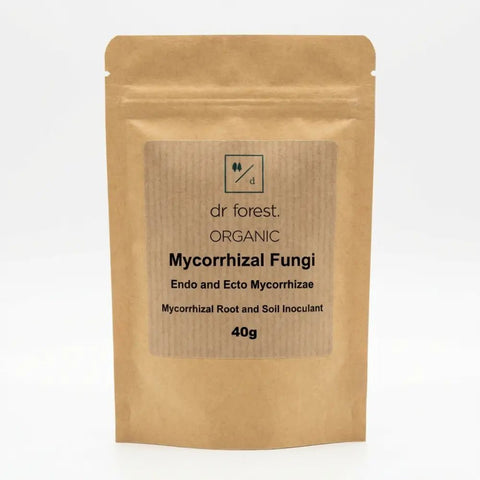
Mycorrhizal Fungi Powder | 18 Species, Endo + Ecto
A root inoculant, 18 endo and ecto species.
from £6.99
Sea shell meal (granular crushed shell)
Ground garden lime (fine calcium carbonate)
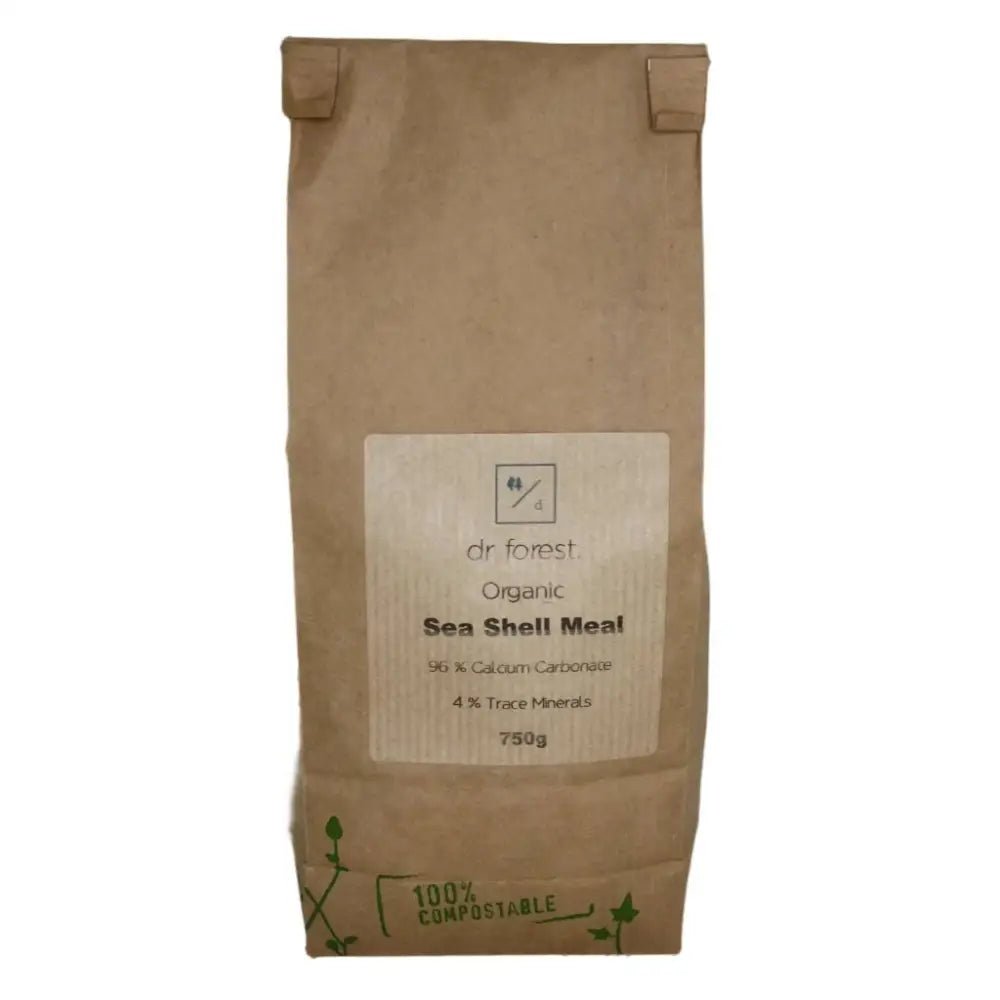
Sea shell meal is crushed marine shell, 36.8% calcium in the form of calcium carbonate, that dissolves slowly in the soil to top up calcium and gently raise the pH of acid ground. Rain leaches calcium out of the root zone and every harvest carries more away, so a cropped soil loses it year on year unless something puts it back. The shell is in granules, so it reacts over seasons, which is what you want for a calcium reserve. Dr Forest sea shell meal comes from natural North Sea deposits, packed in small batches in Stockport, Greater Manchester.
It suits vegetable beds and allotments, tomato and pepper planting holes, lawns on acid soil, and potting mixes short of calcium. Be clear on one thing before you buy: at pH 8 it raises soil pH. On neutral or alkaline soil that only wants calcium, gypsum is the right product instead.
A single-ingredient mineral amendment, nothing added, weighed and packed in small batches at the Dr Forest workshop in Stockport, Greater Manchester. For a walk-through of the calcium and watering side of blossom end rot, read Blossom end rot in tomatoes: what causes it, and how I stopped it. Made by Growers. Backed by Science.
Molluscs build their shells from calcium carbonate pulled out of seawater, laid down as calcite or aragonite in a protein matrix. Whatever else was in the water ends up in the shell in small amounts, which is why crushed shell analyses show iron, magnesium, manganese, cobalt and a fair amount of sodium alongside the calcium. Dr Forest sea shell meal is that shell, from natural North Sea deposits, crushed to a granule with no chemical processing.
In the soil it behaves like any calcium carbonate: the carbonate takes up hydrogen ions, acidity drops, and calcium is released to the exchange sites on clay and organic matter. What differs from a bagged garden lime is particle size, and particle size sets the pace. For why UK soils drift acid, and what changes when you push pH back up, see How to make soil more acidic, or raise the pH.
| Element | Content | Role |
|---|---|---|
| Calcium | 36.8% | Cell walls, cell division, pH buffering, soil crumb |
| Sodium | 5,000 mg/kg | Marine origin; see FAQ on sodium |
| Iron | 2,200 mg/kg | Chlorophyll synthesis, enzyme cofactor |
| Potassium | <500 mg/kg | Minor contribution |
| Sulphur | 470 mg/kg | Protein synthesis |
| Magnesium | 380 mg/kg | Chlorophyll centre atom, enzyme activation |
| Phosphorus | 360 mg/kg | Root development, energy transfer |
| Chromium | 164 mg/kg | Not a plant nutrient; reported for transparency |
| Manganese | 55 mg/kg | Photosynthesis, nitrogen metabolism |
| Cobalt | 16 mg/kg | Needed by nitrogen-fixing bacteria in legume nodules |
| Copper | 6.5 mg/kg | Lignin synthesis |
| Zinc | 5.3 mg/kg | Protein synthesis, hormone production |
Read the table with the rate in mind. Calcium is the reason to buy this; at 200–300 g/m² you add roughly 75–110 g of calcium per square metre. The trace elements are real but small: 2.2 g of iron per kilo is about half a gram per square metre at the bed rate, a top-up and no more. Chromium is listed because it is in the analysis; it has no known role in plant nutrition and we do not claim one.
Calcium has structural roles in the cell wall and membranes and a signalling role inside the cell; White and Broadley's review (2003, Annals of Botany) sets out the physiology and pictures the classic shortfall disorders, tipburn in lettuce and blossom end rot in tomato. Calcium moves up in the water stream and hardly moves again once it has arrived, so every new leaf, root tip and fruit needs a fresh supply from the soil. A reserve in the root zone is how you meet that.
Goulding (2016, Soil Use and Management) reviewed acidification in UK soils: rainfall plays a part, but ammonium fertilisers, urea, elemental sulphur and legumes are the main drivers on cultivated land. Acidity strips base cations, raises aluminium and in bad cases dissolves clay minerals. Target pH for cropped land in the UK is 6.5; Goulding notes far less lime is applied than is needed and many soils sit below optimum. Calcium carbonate reverses the process.
Conyers, Scott and Whitten (2020, Crop and Pasture Science) tracked six particle-size fractions of limestone in the field for eight years. Particles under 0.075 mm gave the largest first-year pH rise per tonne; the coarsest fraction, 2 to 5 mm, still lagged the rest after six years, and unreacted limestone was measurable three to six years after application. Coarse material dissolves over years. The footnote: the fine fractions were no worse for residual pH after seven years, so shell meal is slower but no more effective, which suits a gardener who wants to nudge pH in small steps.
Bronick and Lal (2005, Geoderma) reviewed what holds soil aggregates together: flocculation, cementation, organic carbon, biota and ionic bridging. Cations including calcium bridge particles and stimulate the precipitation of bonding compounds. In practice a calcium-poor clay disperses and sets like a brick; a calcium-supplied clay flocculates into crumbs that drain and let roots through.
Ho and White (2005, Annals of Botany) framed blossom end rot as a calcium shortfall in the far end of the fruit when cell expansion outruns calcium delivery. Topcu, Nambeesan and van der Knaap (2022, Molecular Horticulture) add that apoplastic calcium at the fruit tip predicts the disorder better than total calcium, and that irregular watering is a recognised trigger. Shell meal's job is to make sure supply is never the limit. Even watering is the other half; no amendment replaces it.
Álvarez and colleagues (2012, Pedosphere) compared crushed mussel shell with commercial lime on acid pasture soil in Galicia and found a comparable effect on pH, soil properties and pasture quality, with more calcium in plant tissue. Wider still, Li and colleagues (2019, Journal of Soils and Sediments) pooled 175 liming studies: rate was the main driver of pH change, and calcium carbonate materials averaged a 34% crop yield gain on acid soils. Farm figures on acid land, mind, and no promise for a bed already at pH 6.5. Test first.
Figures describe the published literature on calcium carbonate liming materials and are not product-specific guarantees.
Sea shell meal is a granular product that dissolves slowly in the soil over months and years. Scatter on the soil surface as a top dressing, or mix into growing media at the soil-build stage. Water in after application to begin the dissolution process. The granules do not need to be incorporated deeply; they dissolve progressively from the surface, which makes this product well suited to no-dig systems.
At pH 8 this is a liming material as well as a calcium source. On neutral or alkaline soil, or around ericaceous plants, use gypsum instead. A cheap pH test from any garden centre tells you which you need.
Scatter evenly over the soil surface. Lightly work into the top layer if desired, or leave on the surface for no-dig systems; the granules dissolve from the surface down. Water in thoroughly. A single application at this rate provides sustained calcium release for up to three years, though an annual light top-up of 100–150 g/m² maintains the optimum calcium reserve in intensively cropped soils.
Mix thoroughly into compost or peat-free media before planting. Use the lower rate (5 g/L) for composts that already contain some lime or calcium. Use the higher rate (20–30 g/L) for calcium-poor media such as peat-free compost or acid-tending mixes. The sea shell meal provides a calcium reservoir that lasts the entire growing season and continues into subsequent seasons if the soil is re-used.
Apply 200–400 g/m² in spring and test soil pH the following spring. Sea shell meal at pH 8 raises soil pH gently; expect approximately 0.2–0.4 pH units of correction per season at the higher rate, depending on soil type and starting pH. Heavier soils and very acid soils require the higher rate and may take 2–3 seasons to reach the target. The gentle, sustained correction avoids the pH instability caused by fast-dissolving agricultural lime.
Mix a generous tablespoon (approximately 30 g) into the backfill soil of each planting hole when transplanting tomatoes, peppers, and courgettes. Alternatively, apply 200 g/m² across the entire bed before planting. This provides a calcium reservoir in the root zone that sustains supply during the rapid fruit development phase when blossom end rot is most likely to occur. Combine with consistent, even watering; calcium uptake is disrupted by irregular watering even when calcium is present in the soil.
Broadcast evenly across the lawn and water in. The granules settle between grass blades and dissolve gradually at the soil surface. Apply in autumn to allow the calcium to work into the root zone over winter. Particularly beneficial for lawns on acid soil where moss is a persistent problem; raising pH with sea shell meal creates conditions that favour grass over moss.
Mix into the backfill soil when planting. The sustained calcium release supports root development and cell wall construction during the critical establishment period. Roses in particular are calcium-hungry plants; a generous handful of sea shell meal in the planting hole helps prevent the weak, floppy growth that characterises calcium-deficient roses.
Dr Forest sells both sea shell meal and micronised gypsum. The choice depends on your soil pH. If your soil is acid (below pH 6.5) and you want to raise pH while adding calcium, use sea shell meal; its pH 8 will correct acidity gradually. If your soil is neutral or alkaline (pH 6.5+) and you need calcium without changing pH, use gypsum; it delivers calcium and sulphur at a neutral pH. If in doubt, a simple soil pH test (available from any garden centre) will tell you which to use. There is more on how the two behave in Natural vs synthetic gypsum: does the source matter?
Use alongside Dr Forest Mineral Mix for complete soil mineralisation; the Mineral Mix provides volcanic rock, clay minerals and humic acid alongside the shell meal's calcium and trace minerals. Combine with micronised gypsum only where both pH correction and pH-neutral calcium are needed in different parts of the garden. Apply with Veg 4-4-4 or Bloom 2-8-4 for combined NPK and calcium nutrition. Add to potting mixes alongside Malted Barley; the barley's phosphatase enzyme accelerates the release of the phosphorus content in the shell meal. For surface application technique, see How to top dress like a pro.
Keep sealed in a cool, dry place. This is a stable mineral with an indefinite shelf life; it does not degrade or spoil. It may take up a little moisture if left open, which does not affect it. Reseal after use and keep out of reach of children and pets.
Plants on acid soil that want calcium, which covers most vegetables, especially tomatoes, peppers and brassicas, plus lawns on soil that's turned sour. It also suits calcium-poor potting mixes such as peat-free compost, at 20–30 g per litre. Don't use it on blueberries, rhododendrons, azaleas, camellias or heathers: they want acid soil and shell meal raises the pH. Use gypsum for those if they need calcium.
It's the same mineral, calcium carbonate, but it's easier to use well. Kitchen eggshells are hard to collect in garden quantities and break down slowly unless they're ground very fine. Shell meal is consistent and granular, and you can spread it at a known rate: 200–300 g per m² adds roughly 75–110 g of calcium per square metre, released gradually over up to three years.
At the bed and border rate of 200–300 g per m², a 1.5 kg bag covers about 5–7.5 m², a 4 kg bag about 13–20 m², a 9 kg bag about 30–45 m², and a 15 kg bag about 50–75 m². For a yearly top-up at 100–150 g per m², double those areas. In potting mixes, the rate is 5–30 g per litre of compost.
Scatter it evenly over the soil and water it in, or work it into the top few centimetres. Use 200–300 g per m² on beds and veg plots each spring, 200–400 g per m² to correct acid soil (test again the following spring), 150–250 g per m² on lawns in autumn, and 5–30 g per litre mixed into potting compost. It works slowly, so it won't shift pH overnight.
26% of buyers here also chose Natural Wetting Agent for Plants, Soil & Lawn
A root inoculant, 18 endo and ecto species.
from £6.99


