Liquid Fertiliser
Liquid Bloom Booster | Organic Flowering Feed
A liquid flowering feed for beds, pots and containers.
from £11.00
Free UK Delivery on Orders Over £40


Dr Forest
Couldn't load pickup availability
Dr Forest customers rate us 4.96/5 · 3,543+ reviews & ratings across Shopify, Amazon, Google, Trustpilot and eBay
The vegetative-stage counterpart to our Bloom Booster. This is a living fermented fertiliser made by hand in small batches — nitrogen-rich organic materials, seaweed, and beneficial microorganisms brewed together over months of anaerobic fermentation. The result is a growth-stage supplement that delivers nitrogen and micronutrients for leaf and stem development alongside active microbial cultures and chitin-triggered plant defence compounds from insect frass.
The nitrogen comes from mealworm frass and worm castings — both fermented for three months to convert organic nitrogen into plant-available forms. Scottish seaweed provides natural cytokinins, auxins, and alginates that promote cell division and root development. The EM-1 culture produces vitamins, enzymes, organic acids, and growth-promoting compounds throughout. Use alongside your base Dr Forest fertiliser from transplanting until the first flower buds appear, then switch to the Bloom Booster.
Stage one: mealworm frass, aloe vera, worm castings, humic acid, and filtered water are fermented anaerobically for a minimum of three months at room temperature. This extended fermentation breaks down the organic nitrogen, chitin, and humic compounds into plant-available forms — the Jadam JLF principle. Stage two: Scottish seaweed, EM-1 culture, molasses, and Supa Cera C powder are added and fermented at 25°C+ for approximately two weeks. The final liquid is strained through a 200-micron sieve and bottled.
It has a strong, distinctive smell — this is completely normal and indicates active biological cultures. The odour dissipates rapidly after dilution and application.
Every batch is fermented by hand at our workshop in Stockport, Greater Manchester. The aloe vera is grown organically in-house. The seaweed is sourced from Scotland. No two batches are chemically identical — this is a living product. Supplied in recycled plastic bottles.
A conventional nitrogen fertiliser dissolves a salt in water — ammonium sulphate, urea, calcium nitrate. Fast-acting, biologically dead. A fermented nitrogen source takes organic materials rich in protein and chitin, breaks them down through months of microbial activity, and produces a complex liquid containing plant-available nitrogen plus the living organisms, enzymes, organic acids, and defence-triggering compounds generated during that process. The result feeds both the plant and the soil biology simultaneously.
Insect frass is not just a nitrogen source. It contains chitin — the polysaccharide that forms insect exoskeletons. When chitin enters the soil, it triggers chitinase enzyme production in both plants and soil microorganisms. Chitinase breaks down the cell walls of chitin-containing organisms — including pathogenic fungi and root-feeding nematodes. Plants that detect chitin in their root zone upregulate their defence pathways (a process called "priming"), becoming more resistant to attack before any pathogen arrives. Three months of anaerobic fermentation partially breaks down the chitin, making it more bioavailable and accelerating this defence response.
Seaweed contains cytokinins and auxins — the plant hormones that govern cell division, root initiation, and shoot growth. It also provides alginates (polysaccharides that improve soil structure and water retention), mannitol (a natural chelating agent that improves mineral uptake), and betaines (osmoprotectants that improve stress tolerance). The seaweed is added during the second fermentation stage, where the EM-1 culture further processes these compounds into biologically active forms. British-sourced from the Scottish coastline.
Worm castings are among the most microbiologically diverse organic materials available. They contain plant growth-promoting rhizobacteria (PGPR), beneficial fungi, humic and fulvic acids, and hormone-like compounds that stimulate root growth and nutrient uptake. The three-month anaerobic fermentation extracts these soluble compounds into the liquid phase, concentrating the biological activity of the castings into a form that can be applied as a foliar spray or root drench.
EM-1 (Effective Microorganisms) is a consortium of phototrophic bacteria, lactic acid bacteria, yeasts, actinomycetes, and beneficial fungi. During fermentation, these organisms produce organic acids that solubilise minerals, enzymes that break down organic compounds, antioxidants that protect cell membranes, and plant growth-promoting substances including vitamins and hormone-like molecules. Applied to soil, they colonise the rhizosphere and compete with pathogenic organisms for space and resources — a form of biological disease suppression.
Aloe vera contains salicylic acid — the molecule that triggers systemic acquired resistance (SAR) in plants. SAR is the plant equivalent of an immune memory: once triggered, the entire plant becomes more resistant to a broad spectrum of pathogens. Aloe also contains saponins that act as natural biosurfactants, improving the spread and absorption of foliar applications. Grown organically in-house at Dr Forest HQ in Stockport.
The Veg Booster and Bloom Booster are designed as a pair. Veg Booster delivers nitrogen, chitin, seaweed hormones, and growth-promoting microbes for the vegetative phase — leaf expansion, stem development, root establishment. When flower buds appear, switch to the zero-nitrogen Bloom Booster, which delivers phosphorus, potassium, and reproductive-stage support. Both are fermented with the same EM-1 culture, maintaining biological continuity in the root zone throughout the crop cycle.
Veg Booster is designed to be used alongside your base Dr Forest fertiliser (Veg 4-4-4, All-Purpose 6-6-6, Tomato 3-4-6, etc.) during the vegetative stage. It adds nitrogen, micronutrients, beneficial microbes, and biostimulants on top of your existing programme. It does not replace the base feed.
Strain through a fine sieve or muslin cloth before adding to a sprayer — although pre-strained through 200 micron, additional straining prevents any residual particles from clogging nozzles. Apply as a fine mist to both leaf surfaces in early morning or late evening.
Dilute and apply directly to the root zone. This is the preferred method for delivering the beneficial microorganisms and chitin compounds to the soil. The living EM culture and chitin fragments colonise and prime the rhizosphere on contact. No straining required for watering can application.
Begin weekly applications once plants are actively growing — after transplanting or once seedlings have their first true leaves. Continue throughout the vegetative phase. When flower buds first appear, switch to Dr Forest Bloom Booster for phosphorus, potassium, and zero-nitrogen reproductive support.
Vegetative stage: Base fertiliser (Veg 4-4-4 or All-Purpose 6-6-6) + weekly Veg Booster. Flowering stage: Base fertiliser (Bloom 2-8-4 or crop-specific) + weekly Bloom Booster. Add Seaweed Powder fortnightly throughout and Cal-Mino for chelated calcium during fruit development. This gives you living biology, mineral nutrition, and biostimulants across the entire crop cycle.

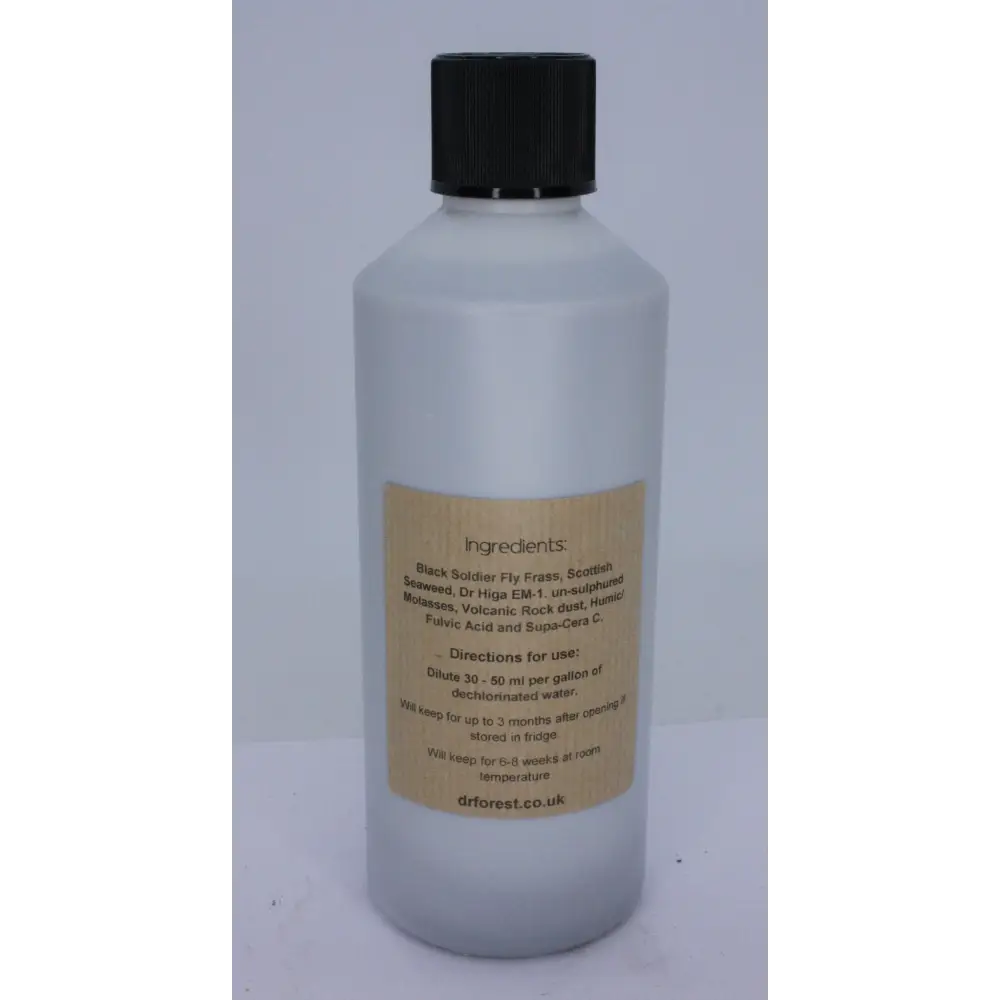

A liquid flowering feed for beds, pots and containers.
from £11.00

Liquid veg and bloom feeds for the whole season.
from £13.50