What are examples of organic fertilisers?
Garden compost, well-rotted manure, seaweed, comfrey and nettle feeds, worm castings, milled meals, and mined minerals such as rock phosphate and sulphate of potash. They sort more usefully by what they do than by where they came from.
Looking for the full answer? See our organic fertiliser FAQ. If you only need one bag, start with All Purpose 4-4-4. To browse the range, open organic fertilisers.
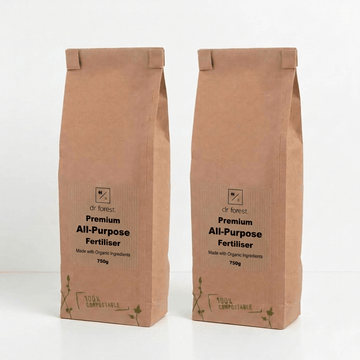
Handcrafted in Stockport
Premium Organic Fertilisers
Concentrated blends, and the single ingredients they are built from. From £6.25
Shop organic fertilisersBulky soil builders
Garden compost, well-rotted manure and leaf mould. Their analysis is low, usually well under 1% nitrogen, so they are poor at correcting a specific shortage. What they are good at is adding organic matter in quantity, which is what actually changes soil structure and water holding. Spread them by the barrowload rather than the handful.
Manure needs to be well rotted before it goes near growing plants. Fresh manure can scorch roots and brings weed seed with it.
Slow-release meals and minerals
Single materials used to supply one thing. Milled meals such as alfalfa and rapeseed carry 2 to 3% nitrogen and break down over weeks. Seaweed meal supplies trace elements and alginates rather than much N, P or K. On the mineral side, rock phosphate is the slow phosphorus reserve, sulphate of potash the concentrated potassium at 50% K₂O, gypsum the calcium and sulphur, and polyhalite four nutrients in one granule.
| Group | Examples | What it is good at |
|---|---|---|
| Bulky soil builders | Compost, well-rotted manure, leaf mould | Organic matter in quantity, structure, water holding |
| Meals and minerals | Alfalfa, rapeseed, seaweed, rock phosphate, sulphate of potash | Correcting one nutrient at a time |
| Concentrated blends | A multi-input bagged feed | One bag covering a crop for a season |
| Homemade liquids | Comfrey, nettle, seaweed or alfalfa steeped in water | Cheap top-ups through the season |
Concentrated blends
A bagged blend combines the meals and minerals above so that one application supplies nitrogen, phosphorus and potassium along with calcium, magnesium, sulphur and trace elements. That is the practical case for buying rather than assembling: getting six nutrients right by mixing single ingredients takes a soil test and some arithmetic.
Dr Forest feeds sit in this group, at fifteen to eighteen inputs per blend, with every one named on the label.
Homemade liquids
Comfrey steeped in water gives a potassium-led feed suited to fruit and flowers. Nettle gives a nitrogen-led one better suited to leafy growth. Both are cheap and both vary batch to batch, so dilute well and treat them as top-ups rather than a measured feed.
Seaweed meal and alfalfa pellets can be steeped the same way if you would rather buy the raw material and brew it yourself.
From the Dr Forest range
Premium Organic Fertilisers
Fifteen to eighteen inputs per blend, every one named, or the single ingredients on their own if you would rather build the programme yourself.
Blends and single ingredients · Every ingredient named · Rates published
Browse the organic fertiliser rangeMore organic fertiliser questions
What is organic fertiliser made of?What is the best natural fertiliser?What is the best source of organic fertiliser?Sources
- Royal Horticultural Society. Fertilisers: types and uses. rhs.org.uk
- Royal Horticultural Society. Organic matter: how to use it in the garden. rhs.org.uk
- Royal Horticultural Society. Homemade fertilisers. rhs.org.uk
Soil notes
Get the evidence, not the marketing
Occasional notes from Stockport on feeding, soil structure and what the research actually supports, including the things that turn out not to work.
No spam. Unsubscribe in one click. See our privacy notice.