
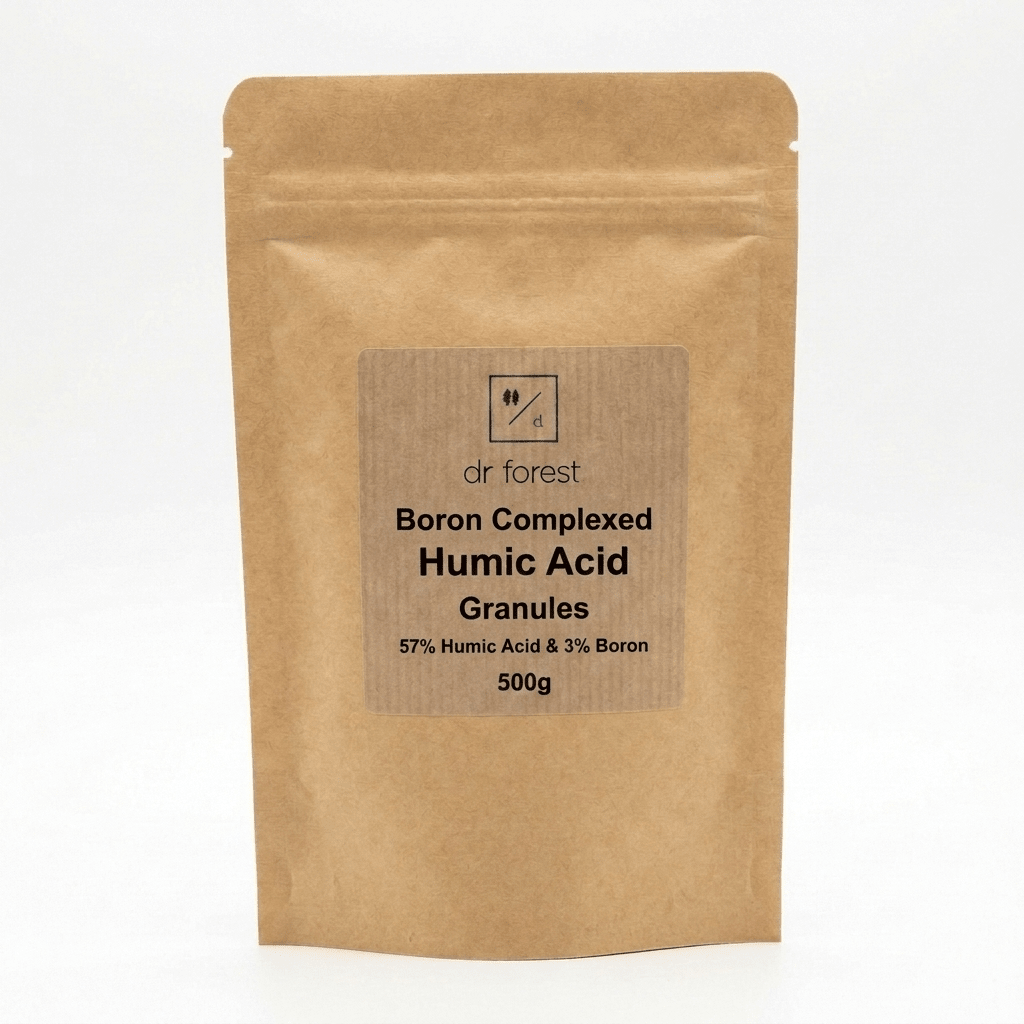
Boron humate granules, 3.23% boron complexed with humic acid, slow release
Boron humate is boron fused with humic acid and pressed into a 2–4 mm granule, so the boron releases over a full growing season instead of washing out with the first heavy rain. Boron is the most leachable of the trace elements. In sandy or low-humus soils a soluble boron feed can be halfway to the water table before the plant has drawn on it. Binding it to humic acid holds it in the root zone.
Boron matters most at flowering. It governs pollen tube growth, seed and fruit set, sugar transport, and the cross-linking of pectin in cell walls. It also governs how efficiently the plant takes up and distributes calcium, which is why boron shortage and calcium disorders so often turn up together. Deficiency shows as poor fruit set, hollow or corky stems, distorted new growth and brittle leaves.
This is a corrective input, not a routine feed. Because the safe window for boron is narrower than for any other nutrient, we would rather you tested the soil first than applied it on suspicion.
Boron has the narrowest safe window of any plant nutrient. The gap between sufficiency and toxicity is smaller than for any other element. Weigh the dose. Do not apply more often than the schedule below, and do not use it on a bed that has already had a boron-containing feed this season.
What it is for
- Poor fruit set — flowers that open and drop without setting fruit, on tomatoes, courgettes, beans and top fruit.
- Sandy and free-draining soils — where soluble boron leaches out before the plant can use it.
- Brassicas and root crops — swede, turnip, beetroot and cauliflower are the classic boron-hungry group; brown or hollow hearts are the tell.
- Calcium disorders that persist — where calcium is present in the soil but is not reaching the fruit.
- Blending into a granular feed — the granule size matches most dry fertilisers, so it mixes without separating out.
Boron humate granules
Boron held on a humic acid backbone. Releases across the crop cycle as soil biology works on the humate. Resists leaching. Granular, so it can be broadcast or blended into a dry feed.
Soluble borax or boric acid
Fully available on day one, gone within weeks on a light soil. Easy to overdose because the whole dose is plant-available at once. Useful for a fast correction, poor for season-long supply.
Made by Growers. Backed by Science.
Why complex boron with humic acid
Boron moves through soil as borate, a small uncharged or singly-charged species that most soils hold poorly. On a sandy, low-organic-matter soil it behaves much like nitrate: it goes where the water goes. Organic matter is the main thing that slows it down.
Organic matter binds borate
Yermiyahu, Keren and Chen (1995, Soil Science Society of America Journal 59:405–409) showed that boron sorption rose as the organic matter content of the soil increased, holding borate against loss to drainage. Complexing boron onto humic acid before it ever reaches the soil applies the same chemistry at source.
Boron is structural, not catalytic
Boron cross-links rhamnogalacturonan-II in the pectin network of the primary cell wall. Goldbach and Wimmer (2007, Journal of Plant Nutrition and Soil Science 170:39–48) set out how this cross-linking governs wall stability and membrane function. Without it, new tissue is brittle and malformed, which is why deficiency shows first in growing points.
Pollination is the sensitive window
Brown and colleagues (2002, Plant Biology 4:205–223) reviewed boron in plant biology and identified pollen germination and pollen tube elongation as among the most boron-sensitive processes in the plant. A shortfall at flowering costs yield even where vegetative growth looks fine.
Low boron is a whole-plant problem
Dell and Huang (1997, Plant and Soil 193:103–120) catalogued the physiological consequences of low boron: impaired root elongation, disrupted sugar transport, reduced calcium mobility. The symptoms are diffuse, which is part of why boron shortage is so often missed.
The humate is not just a carrier
At 57.2% humic acids the carrier does work of its own. Rose and colleagues (2014, Advances in Agronomy 124:37–89) pooled published trials of humic substances and found mean increases of roughly a fifth in both root and shoot dry weight. The caveat belongs with the figure: that same analysis found humic substances from compost sources outperformed those from lignite and brown coal, and this humate is leonardite-derived. Nardi and colleagues (2002, Soil Biology & Biochemistry 34:1527–1536) and Canellas and Olivares (2014) describe the mechanism, which is auxin-like activity on root cells.
The toxicity margin is real
Goldberg (1997, Plant and Soil 193:35–48) puts it plainly: the range between deficient and toxic boron is smaller than for any other nutrient element. Nable, Bañuelos and Paull (1997, Plant and Soil 193:181–198) reviewed what toxicity looks like when it does happen, and how slow and expensive it is to reverse in the field. Slow release widens the practical margin because the plant never meets the whole dose at once. It does not remove it.
References
- Brown, P.H. et al. (2002). Boron in plant biology. Plant Biology 4:205–223.
- Canellas, L.P. & Olivares, F.L. (2014). Physiological responses to humic substances as plant growth promoter. Chemical and Biological Technologies in Agriculture 1:3.
- Dell, B. & Huang, L. (1997). Physiological response of plants to low boron. Plant and Soil 193:103–120.
- Goldbach, H.E. & Wimmer, M.A. (2007). Boron in plants and animals: is there a role beyond cell-wall structure? Journal of Plant Nutrition and Soil Science 170:39–48.
- Goldberg, S. (1997). Reactions of boron with soils. Plant and Soil 193:35–48.
- Nable, R.O., Bañuelos, G.S. & Paull, J.G. (1997). Boron toxicity. Plant and Soil 193:181–198.
- Nardi, S. et al. (2002). Physiological effects of humic substances on higher plants. Soil Biology & Biochemistry 34:1527–1536.
- Rose, M.T. et al. (2014). A meta-analysis and review of plant-growth response to humic substances. Advances in Agronomy 124:37–89.
- Yermiyahu, U., Keren, R. & Chen, Y. (1995). Boron sorption by soil in the presence of composted organic matter. Soil Science Society of America Journal 59:405–409.
How to use boron humate granules
A level teaspoon of granules is roughly 4 g. The garden rate below is 1–2 g per square metre, so a quarter to half a level teaspoon spread across a whole square metre. This is not a product to apply by eye. A kitchen scale is accurate enough.
General soil broadcast
Scatter evenly over the bed and rake in lightly, or apply to the surface of an established bed and water in. Use the lower end on loam and clay, the upper end on sand and other free-draining soils where leaching is the problem.
Absolute ceiling: 3 g per m² broadcast. Never exceed this, whatever the soil type.
Blended into a granular feed
Mix up to 40 g of granules into every 1 kg of dry fertiliser before spreading. The 2–4 mm granule size matches most dry feeds, so the blend stays even rather than separating out in the bag.
Then watch the rate of the finished blend, not just the inclusion percentage. At 4% inclusion, apply no more than 50 g of blend per square metre. That puts 2 g of boron humate on the ground, which is where you want to be.
Pre-flower application on fruiting crops
Apply two to four weeks before flowers open on tomatoes, courgettes, beans, top fruit and soft fruit. Because release is gradual, the boron needs to be in the ground ahead of the flowering window rather than during it.
Brassicas and root crops
Swede, turnip, beetroot and cauliflower have the highest boron requirement of the common garden crops, and brown heart in swede and hollow stem in cauliflower are the classic symptoms. Work into the top 100–150 mm before sowing or planting out.
Applying around individual plants or in a band concentrates the dose into a fraction of the bed area, so the ceiling is lower. Do not exceed the equivalent of 1.5 g per m² where the granules are banded or placed around individual plants rather than spread across the whole surface.
Applying it
- Weigh the dose for the area. Do not estimate. A kitchen scale is accurate enough.
- Scatter evenly across the whole area rather than concentrating it near stems or crowns.
- Rake into the top few centimetres if the bed is empty, or leave on the surface if planted.
- Water in. The granule needs moisture and soil biology to begin releasing.
- Note the date. One application per bed per season is the limit.
If you are already using a feed that contains boron, whether that is a trace element mix, a cal-mag product, or a compound fertiliser listing boron on the label, do not add this on top in the same season. Boron accumulates. Symptoms of excess are leaf margin scorch and tip burn on older leaves first.
Pair with Humic Acid Flakes where you want an immediate soluble humic input for drenching or fertigation alongside the slow-release granule. Fulvic Acid Powder is the foliar-friendly chelator of the pair. Neither contains boron, so neither stacks with this product.
Questions
What is humic acid? · Benefits of humic acid for plants · How to apply humic acid · Humic vs fulvic acid


