Skip to product information
1 of 2

Dr Forest

Magnesium Fertiliser UK | Micronised Solution Grade

Magnesium Fertiliser UK | Micronised Solution Grade

Regular price £6.99 GBP
Regular price Sale price £6.99 GBP
Sale Sold out
Shipping calculated at checkout.
Size
Quantity

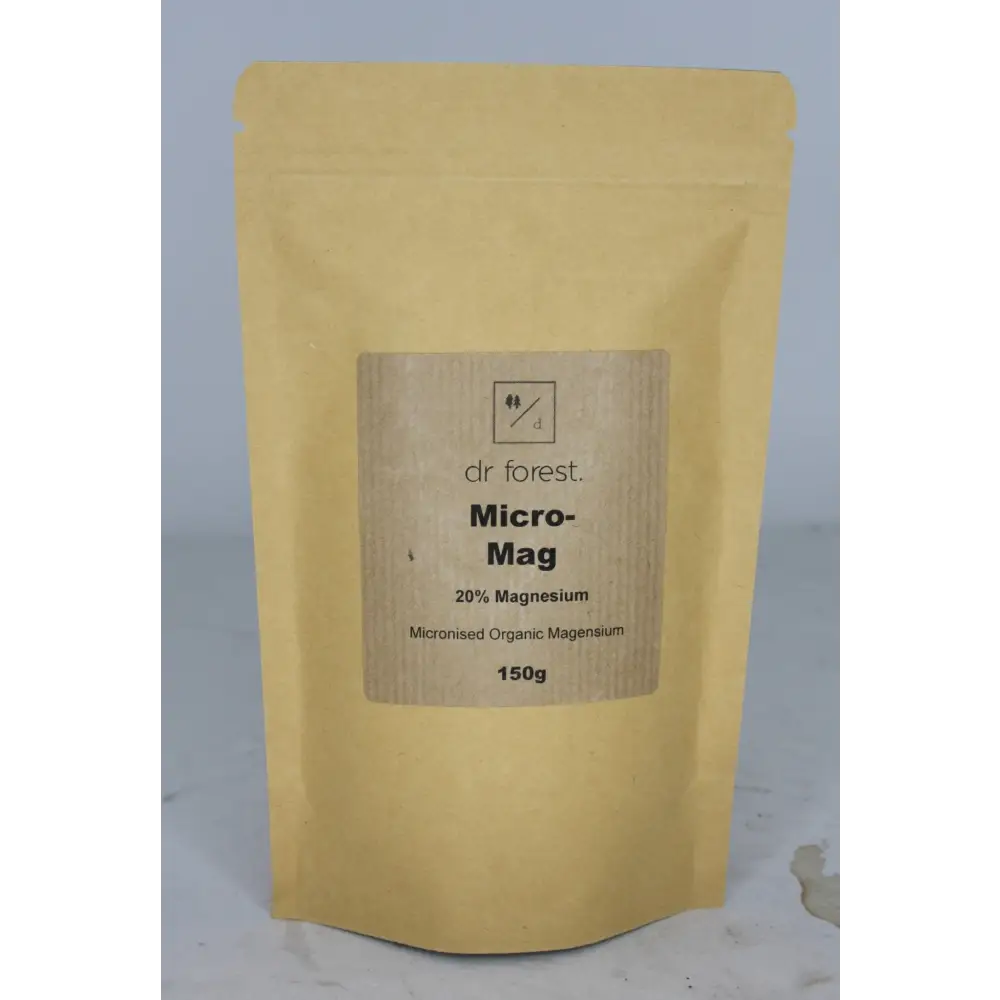
Micro-Mag — micronised magnesium carbonate, solution-grade mineral fertiliser

Micronised Powder Solution Grade Foliar & Soil Drench Natural Mineral Organic Approved Quarry-Extracted

Magnesium sits at the centre of every chlorophyll molecule. Without it, photosynthesis cannot function. Deficiency shows as interveinal chlorosis on older leaves — yellow tissue between green veins, spreading upward as the plant cannibalises old growth to feed new. It is one of the most common nutrient deficiencies in UK gardens, particularly in containers, raised beds, sandy soils, and acidic conditions where magnesium leaches readily.

Micro-Mag is a natural magnesium carbonate quarried and micronised to solution-grade fineness. The ultra-fine particle size means it suspends in water for foliar spraying and soil drenching, or can be broadcast directly onto soil for longer-term correction. Pure mineral origin, no synthetic processing, no additives. Suitable for organic growing systems.

MgCO₃Magnesium Carbonate
MicronisedSolution Grade
Foliar& Soil Drench
NaturalMineral Origin

What Micro-Mag is used for in the garden

  • Correcting magnesium deficiency — interveinal chlorosis on older leaves is the classic symptom; common in tomatoes, peppers, roses, citrus, and brassicas, especially during heavy fruiting when demand spikes
  • Boosting photosynthesis — magnesium is the central ion in chlorophyll; adequate supply directly increases the plant's ability to convert light energy into sugars and growth
  • Improving fruit quality and flavour — sugar production depends on photosynthetic efficiency; magnesium-sufficient plants produce sweeter, more flavourful fruit and vegetables
  • Foliar spray for rapid correction — the micronised particle size allows suspension in water for direct foliar application where deficiency symptoms are already visible
  • Soil remineralisation — broadcast application replenishes magnesium reserves in depleted soils, particularly sandy, acidic, or heavily cropped ground
  • Enzyme activation — magnesium activates over 300 enzymes in plants, including those involved in energy transfer (ATP), nitrogen metabolism, and protein synthesis
  • Lawn and turf colour — magnesium is directly responsible for the depth of green in turf; deficient lawns appear pale even with adequate nitrogen

Why micronised magnesium carbonate instead of Epsom salt?

Micronised Magnesium Carbonate — Micro-Mag

  • Natural mineral — quarried, ground, and packaged with no chemical processing
  • Micronised to solution-grade — suspends in water for foliar or drench use
  • Also effective as a dry broadcast for longer-term soil correction
  • Gentle pH buffering — helps neutralise acidic soils where Mg is most deficient
  • Low salt index — no risk of salt stress to roots or leaves
  • Organic approved

Epsom Salt (Magnesium Sulphate)

  • Fully water-soluble and fast-acting — but leaches rapidly from the root zone
  • Also provides sulphur (13% S) — useful where sulphur is also deficient
  • Higher salt index than magnesium carbonate
  • No pH buffering effect — does not help acidic soils
  • Needs repeated application as it washes through with watering and rain
Handcrafted in Stockport

Every Dr Forest product is made by hand in small batches at our workshop in Stockport, Greater Manchester. We source ingredients for quality, not cost. Recyclable packaging on the 1.5 kg and 3 kg sizes.

The science of magnesium in plant nutrition

Why magnesium is irreplaceable

Magnesium is the only metallic element in chlorophyll. Every chlorophyll molecule contains a single magnesium ion at its centre, coordinated within a porphyrin ring. Without this ion, the molecule cannot absorb light energy and photosynthesis stops. No other element can substitute.

Beyond chlorophyll, magnesium activates over 300 enzymatic reactions including ATP synthesis, ribosomal protein synthesis, and carbohydrate partitioning. It stabilises ribosome structure and is required for RNA polymerase activity. Magnesium is involved in nearly every metabolic process that keeps a plant alive and productive.


01

Chlorophyll Synthesis & Photosynthesis

Each chlorophyll a and chlorophyll b molecule requires one Mg²⁺ ion. Magnesium-deficient plants produce less chlorophyll, reducing photosynthetic capacity and total sugar, starch, and biomass production. Symptoms appear on older leaves first because magnesium is phloem-mobile — the plant remobilises it from old tissue to sustain new growth, sacrificing the oldest leaves first.

02

Energy Transfer — ATP Requires Magnesium

ATP (adenosine triphosphate) must be complexed with Mg²⁺ to be enzymatically active. Magnesium is therefore required for every energy-dependent process: nutrient uptake, sugar transport, protein synthesis, cell division, and defence responses. Plants with marginal Mg show reduced growth rates even before visible chlorosis appears.

03

Sugar Transport to Fruit

Magnesium is essential for phloem loading — the process by which sugars produced in leaves are loaded into the phloem for transport to developing fruit, roots, and storage organs. Magnesium-deficient plants accumulate sugars in the leaves while fruit development suffers from inadequate carbon supply. This directly reduces yield, flavour, and storage quality.

04

Cation Antagonism — K:Mg Balance

Potassium and magnesium compete for the same root uptake sites. High potassium levels — common in container growing where potassium-rich feeds are used heavily — can induce magnesium deficiency even when soil Mg is adequate. This is one of the most common causes of interveinal chlorosis in container-grown tomatoes and peppers. The solution is not less potassium but more magnesium to restore the balance.

05

Micronisation & Surface Area

Magnesium carbonate in its coarse form dissolves slowly in soil moisture over weeks to months. Micronisation dramatically increases the surface area to volume ratio, accelerating dissolution. Solution-grade micronised magnesium carbonate can be suspended in water for foliar spray or soil drench, giving faster availability than coarse rock dust while retaining the gentle, low-salt-index characteristics of a carbonate source.

06

pH Buffering in Acidic Soils

Magnesium deficiency is most common in acidic soils because Mg²⁺ is displaced from exchange sites by H⁺ ions and leached by rainfall. Magnesium carbonate has a mild alkalising effect — as it dissolves, it releases carbonate ions that neutralise soil acidity. This simultaneously corrects the deficiency and addresses one of its root causes. Epsom salt, by contrast, is pH-neutral and does nothing for acidity.

Scientific References

  1. Cakmak, I. & Yazici, A.M. (2010). Magnesium: A forgotten element in crop production. Better Crops, 94(2), 23–25.
  2. Verbruggen, N. & Hermans, C. (2013). Physiological and molecular responses to magnesium nutritional imbalance. Plant and Soil, 368, 87–99.
  3. Guo, W. et al. (2016). Magnesium deficiency in plants: An urgent problem. The Crop Journal, 4(2), 83–91.
  4. Mengel, K. & Kirkby, E.A. (2001). Principles of Plant Nutrition. 5th ed. Kluwer Academic.

How to use Micro-Mag: application rates & guide

Solution-grade micronised powder

Micro-Mag suspends in water for foliar spraying and soil drenching. Stir or shake well before and during application — as a mineral suspension it will settle over time. It can also be broadcast directly onto soil as a dry amendment for longer-term correction.

Application rates

Soil drench — liquid application

Rate: 0.5–1g per litre of water  |  Frequency: Every 2–4 weeks during the growing season

Suspend in water and apply to the root zone. Particularly effective for container-grown crops where magnesium leaches quickly and K:Mg imbalance is common. Use the higher rate where deficiency symptoms are visible.

Foliar spray — rapid deficiency correction

Rate: 0.5–1g per litre of water  |  Frequency: Every 7–14 days until symptoms resolve

Spray both leaf surfaces in early morning or late evening. Magnesium is phloem-mobile, so foliar-applied Mg can be transported from sprayed leaves to growing tips and developing fruit. Stir the solution regularly during spraying to maintain suspension.

Soil broadcast — dry application for beds and borders

Rate: 75–250g per m²  |  Frequency: Once or twice per year

Scatter evenly and work into the top layer if possible. Water in. The micronised particles dissolve faster than coarse rock dust but still provide sustained release. Use the higher rate for known-deficient or acidic soils.

Trees and shrubs

Rate: 0.8–1.6 kg per plant  |  Frequency: Annually in spring

Spread around the drip line and work lightly into the soil. Water in thoroughly. Particularly important for fruit trees, citrus, and ornamentals showing deficiency symptoms.

Lawns and turf

Rate: 50–80g per m²  |  Frequency: Once or twice per year, spring and autumn

Broadcast evenly and water in. Magnesium directly improves the depth of green in turf. Apply alongside a balanced lawn feed for best results.

Step-by-step preparation for liquid application

  1. Measure the powder. For a 10-litre watering can, measure 5–10g (1–2 level teaspoons).
  2. Add to water and stir vigorously. The micronised powder will suspend in water but may settle. Stir or shake regularly during application.
  3. Apply to foliage or root zone. For foliar sprays, use a sprayer with good agitation. For root drenches, apply evenly around the base of the plant.
  4. Repeat as needed. For active deficiency, apply every 1–2 weeks. For maintenance, every 2–4 weeks.
  5. Store dry powder sealed. Keep in a cool, dry place. Magnesium carbonate is stable and has an indefinite shelf life when kept dry.
Works well combined with…

Use alongside Yorkshire Polyhalite (which also contains 6% MgO) for baseline slow-release magnesium. Pair with Seaweed Powder for biostimulant activity and improved foliar wetting. For a complete micronutrient programme, add Micro-Amino (chelated Fe, Zn, Mn, B, Cu, Mo) to address the full spectrum of trace element needs.

Frequently asked questions about Micro-Mag

The classic symptom is interveinal chlorosis on older leaves — the tissue between the veins turns yellow while the veins remain green. Because magnesium is mobile in the plant, it is pulled from old leaves to supply new growth, so symptoms always appear on the lower and middle leaves first. In severe cases, leaves develop brown necrotic patches and drop prematurely. Tomatoes, peppers, roses, and citrus are particularly susceptible.
Epsom salt (magnesium sulphate) is fully water-soluble and fast-acting but leaches rapidly — it needs frequent reapplication. Micro-Mag is micronised magnesium carbonate: it provides more sustained release, has a mild pH-buffering effect that helps acidic soils, and has a lower salt index. Epsom salt also provides sulphur, which is useful where both magnesium and sulphur are deficient — but for magnesium correction alone, Micro-Mag is more persistent and effective.
Yes — the micronised particle size allows it to be suspended in water and applied through a sprayer. Stir or shake the solution regularly during use as the particles will settle. Magnesium absorbed through the leaves is phloem-mobile and can be transported to wherever the plant needs it most. Foliar application is the fastest way to correct visible deficiency symptoms.
Tomatoes are heavy feeders with high potassium demand during fruiting. Most tomato feeds are potassium-rich, and potassium competes directly with magnesium for root uptake. The more potassium you apply, the more likely you are to induce magnesium deficiency — even in soil that contains adequate Mg. The solution is to supplement magnesium alongside your potassium-rich feed, not to reduce potassium. Micro-Mag as a fortnightly foliar spray during fruiting is an effective preventive approach.
Magnesium carbonate has a mild alkalising effect — it will gently raise the pH of acidic soils over time. This is a benefit in most cases, as magnesium deficiency is most common in acidic conditions. However, if you are growing acid-loving plants like blueberries or rhododendrons and want to avoid raising pH, use Micro-Mag as a foliar spray only — foliar application delivers magnesium to the plant without affecting soil pH.
Yes. Micro-Mag is a natural mineral — quarry-extracted magnesium carbonate with no synthetic processing or chemical additives. It is suitable for use in organic growing systems.
Yes. Magnesium is directly responsible for the depth of green colour in turf. Deficient lawns appear pale and yellowish even with adequate nitrogen. Apply 50–80g per m² as a dry broadcast, or dissolve in water and apply with a watering can or sprayer. One or two applications per year — spring and autumn — are usually sufficient.
Magnesium carbonate is not fully water-soluble like Epsom salt. The "solution grade" description refers to the ultra-fine particle size — micronised to the point where it suspends in water effectively for spraying and drenching. It will settle over time, so stir or agitate regularly during application. This is normal for mineral suspension products.
The 1.5 kg and 3 kg sizes are supplied in recyclable packaging. The 500g size is not currently in recyclable packaging.
View full details