
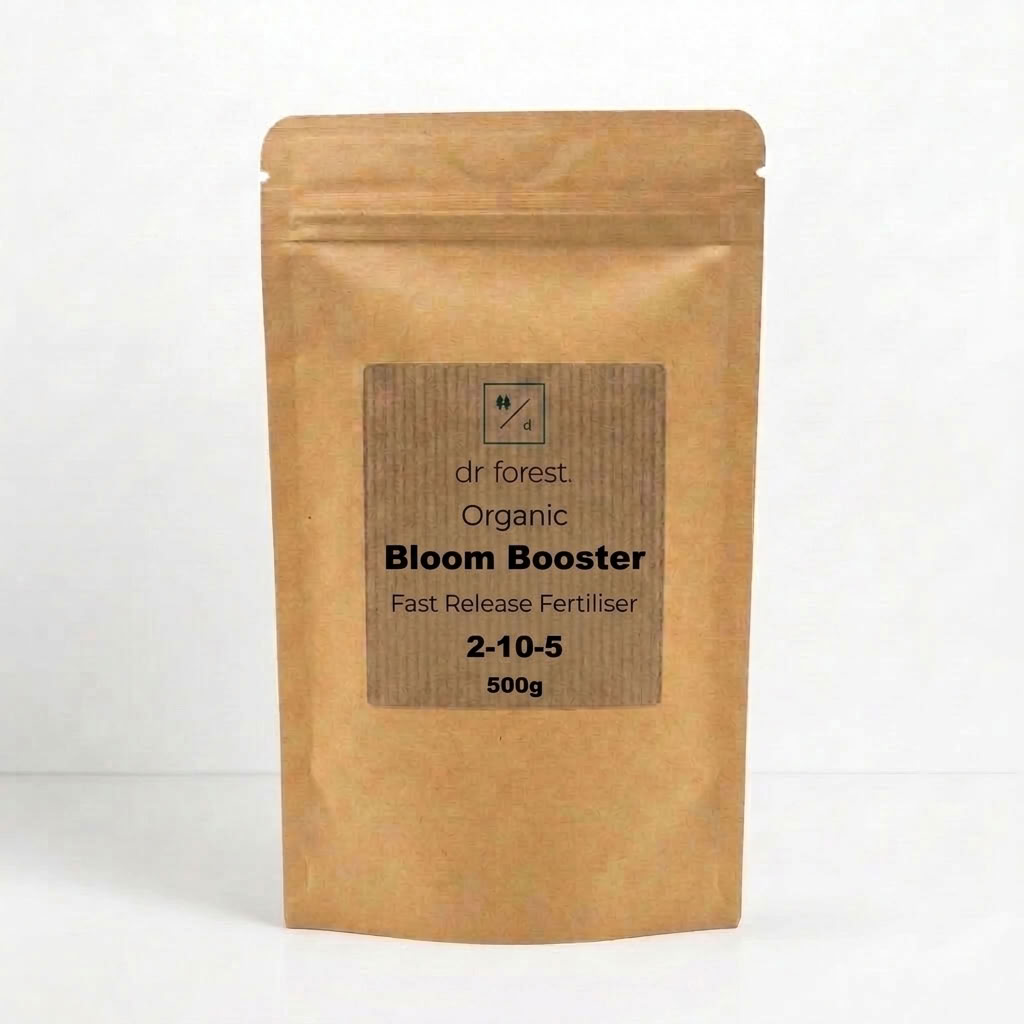
Organic Bloom Booster 2-10-5 — a fast-acting soluble powder for the exact moment a plant sets flower
Bloom Booster 2-10-5 is a solution-grade powder built around the moment a plant shifts from leafy growth to flowering and fruiting. It makes up into a liquid solution when added to water, reaching the root zone within hours — a deliberately low-nitrogen, high-phosphorus ratio that supports flower and fruit development rather than more leaf.
The phosphorus (micronised rock phosphate) and calcium (micronised gypsum) are milled to an ultra-fine particle size for fast breakdown, while nitrogen (amino acids) and potassium (Sulphate of Potash) go fully into solution. Magnesium now comes from Kieserite, a naturally mined mineral, in place of the Epsom salt used previously. Soluble seaweed extract and humic and fulvic acid complete the formula.
This is a timed intervention, not a season-long feeding programme. It is applied at flowering and through fruit set — see Booster vs granular below, and the timing guide on the How to Use tab.
What Bloom Booster is used for in the garden
- First flower trigger — the moment a tomato, chilli, courgette or bean plant sets its first bud is the signal to switch from a nitrogen-led feed to Bloom Booster
- Through fruit set and swell — repeated applications support the phosphorus and potassium demand of developing fruit
- Roses and flowering shrubs — a bud-to-bloom boost timed to flush cycles, for more flowers and stronger colour
- Strawberries and soft fruit — applied from flowering through fruiting for size and yield
- Orchids and container flowering plants — a gentle, low-rate feed timed to bud development
- Fruit trees — supports blossom and early fruit set in spring
- Reviving a reluctant flowerer — a plant that's leafy but won't bloom often responds to a lower-nitrogen, higher-phosphorus drench within days
Booster vs granular — two different jobs
Bloom Booster 2-10-5 (soluble powder, fast release)
- Mixes into a liquid solution — nutrients reach the root zone within hours
- Applied at the moment a plant sets flower, and through fruit set
- Concentrated powder — you add the water, no shipping weight
- No standing nutrient reserve in the soil between applications
Organic Bloom Fertiliser 2-8-4 (granular, slow release)
- Breaks down over weeks as soil microbes and moisture work on it
- Applied at planting or on a schedule as the background feed for flowering and fruiting beds
- One application covers weeks, not one watering
- Builds a standing nutrient reserve — but can't respond to the exact day a plant sets flower
All seven inputs — what they do and why each one is in the formula
Bloom Booster's 2-10-5 ratio is deliberately low in nitrogen and high in phosphorus, so every input is chosen to support flower and fruit development without pushing more leaf. Two ingredients changed in this recipe: potassium now comes from Sulphate of Potash rather than a micronised potassium mineral, and magnesium now comes from Kieserite rather than Epsom salt.
Micronised rock phosphate — phosphorus, the lead nutrient
Phosphorus drives flower and root development and is the largest single input in this formula. Milling it to an ultra-fine particle size increases its reactive surface area so it starts releasing within days rather than sitting inert in the soil.
Sulphate of Potash — potassium, fully soluble
Sulphate of Potash (SOP) is roughly 50% K₂O and 18% sulphur, and it is genuinely chloride-free. It replaces the micronised potassium mineral used previously: because SOP dissolves completely in water, potassium — the nutrient that governs fruit quality, sugar transport and colour — is now fully soluble rather than split between a fast and a slow-release form.
Amino acids — nitrogen, kept deliberately low and soluble
A small, fast-acting nitrogen input that supports the plant without triggering the leafy growth that competes with flowering. Amino acids are absorbed directly by root transporters rather than waiting on microbial conversion.
Micronised gypsum — calcium, fast-breaking mineral
Calcium is essential for cell wall strength in developing fruit — a shortfall shows up as disorders like blossom end rot in tomatoes. The micronised form keeps pace with the fast phosphorus and potassium in this formula.
Kieserite — magnesium, naturally mined mineral
Kieserite (magnesium sulphate monohydrate) is roughly 25% MgO and 50% SO₃. It replaces the Epsom salt previously used in this formula. Magnesium sits at the centre of the chlorophyll molecule, and a shortfall during heavy fruiting shows up as interveinal yellowing on older leaves. As a mined mineral, Kieserite also contributes further sulphur to the feed.
Soluble seaweed extract — hormones and trace minerals
Natural cytokinins and auxins support fruit set and reduce flower and fruit drop under stress, alongside over 60 trace elements in immediately available form.
Humic and fulvic acid — uptake enhancement
Fulvic acid chelates the mineral nutrients in the drench and increases root cell membrane permeability, so the phosphorus and potassium this formula relies on are absorbed more efficiently.
How to use Bloom Booster: preparation, rates & timing
Add the measured amount to water and stir briefly. The soluble fraction dissolves completely; the micronised fraction forms a fine, stable suspension. Mix fresh for each application — don't store the diluted solution.
Application rates by plant
Tomatoes, chillies & peppers
Start the day the first truss sets flower and continue through harvest for consistent fruit development.
Roses & flowering shrubs
Timed to bud formation for stronger blooms and better colour through each flowering flush.
Strawberries & soft fruit
Supports fruit size and yield through the flowering-to-fruiting window.
Annuals & bedding plants
Extends the flowering display and keeps colour going through the season.
Orchids & container flowering plants
A gentle rate suited to sensitive container plants and orchid roots.
Fruit trees
Two well-timed applications in spring support blossom retention and early fruit set.
Step-by-step preparation
- Measure the powder. ¼ teaspoon (approx. 1g) per litre for sensitive plants, up to ½ teaspoon (approx. 2.5g) for heavy fruiters like tomatoes.
- Add to water and stir. The soluble fraction dissolves within seconds; the micronised fraction forms a fine suspension.
- Apply as a root drench. Saturate the root zone; for containers, apply until a little runs through the drainage holes.
- Use fresh. Mix only what you need — don't store the diluted solution.
Use the granular Bloom Fertiliser 2-8-4 as the background feed for a flowering or fruiting bed. Reach for Bloom Booster at the specific moment a plant sets its first flower — that's the trigger to switch — and keep applying through fruit set. Getting the timing right does more for flowering and fruit than an early or extra granular application.
Switch to Bloom Booster from All-Purpose Booster 5-5-5 the moment first flower appears. Use alongside the granular Bloom Fertiliser 2-8-4 as the base feed, with Booster as the liquid top-up through the flowering and fruiting window. Add Seaweed Powder to the same watering can to help reduce flower and fruit drop under stress.
The science of fast-release feeding: why a soluble drench and a slow-release granular are not interchangeable
Two release curves, two jobs
A granular fertiliser like Bloom Fertiliser 2-8-4 is built to be slow. Its minerals are sized so that soil moisture and microbial activity break them down gradually over weeks, releasing a steady trickle of phosphorus and potassium that a bed can draw on through the season. That's the right behaviour for background feeding — but the release curve is fixed the moment the granules go down. It can't respond to the exact day a plant sets its first flower.
Bloom Booster inverts that curve deliberately. Every input is chosen to dissolve or break down within hours to days: amino acid nitrogen and Sulphate of Potash go into solution completely; the micronised rock phosphate, gypsum and Kieserite are milled fine enough to behave as near-soluble. The result is a feed you apply because a plant has just crossed into flowering, not on a fixed calendar.
Granular 2-8-4 — steady background supply
- Release rate fixed by particle size and soil biology at the time of application
- One application covers the whole bed for weeks
- Cannot be timed to the exact day a plant sets flower
- Builds a standing reserve in the soil
Bloom Booster — on-demand pulse
- Release rate is hours, regardless of soil biology
- Applied in direct response to first flower and fruit set
- Can be layered on top of a granular feed without disrupting it
- No standing reserve — nutrients are used or leached within days
Why sulphate of potash matters more in a bloom formula
Potassium regulates the movement of sugars into developing fruit and governs fruit quality, firmness and colour — arguably the nutrient with the most direct effect on the finished crop in a bloom feed. The mineral this formula used previously was micronised but still part of the slower-breaking fraction. Sulphate of Potash is a genuinely soluble salt, so switching to it puts the full potassium supply into solution alongside the phosphorus, meaning both arrive at the root zone together at the moment they're needed most.
Five mechanisms of action
Phosphorus for Flower & Root Development
Phosphorus is central to the energy transfer (ATP) that drives cell division in developing flower buds and roots — the reason this formula leads with it.
Soluble Potassium for Fruit Quality
Potassium activates the enzymes that load sugars into fruit and regulates stomatal function, affecting firmness, sweetness and colour. Delivering it in fully soluble form means it's available exactly when fruit is filling.
Sulphur From Two Mineral Sources
Sulphate of Potash and Kieserite both carry sulphur alongside their headline nutrient — a component of several enzymes and of chlorophyll synthesis, easy to under-supply in a simple N-P-K view of feeding.
Fulvic Acid Chelation & Membrane Transport
Fulvic acid wraps mineral nutrients in a form that resists binding to soil particles and increases root cell membrane permeability, improving uptake of the phosphorus and potassium this formula relies on.
Calcium & Magnesium Alongside Fast Phosphorus
Fast-developing fruit has a high calcium demand — a shortfall shows as blossom end rot in tomatoes — while magnesium sits at the centre of the chlorophyll molecule. Micronised gypsum and Kieserite are included to keep pace with the phosphorus-driven fruiting response.
Scientific References
- Marschner, H. (2012). Mineral Nutrition of Higher Plants (3rd ed.). Academic Press.
- Taiz, L. & Zeiger, E. (2015). Plant Physiology and Development (6th ed.). Sinauer Associates.
- Ho, L.C. & White, P.J. (2005). A cellular hypothesis for the induction of blossom-end rot in tomato fruit. Annals of Botany, 95(4), 571–581.
- Canellas, L.P. & Olivares, F.L. (2014). Physiological responses to humic substances as plant growth promoters. Chemical and Biological Technologies in Agriculture, 1(1), 3.
- Shukla, P.S. et al. (2019). Ascophyllum nodosum-based biostimulants. Frontiers in Plant Science, 10, 655.
- Lambers, H. et al. (2006). Root structure and functioning for efficient acquisition of phosphorus. Annals of Botany, 98(4), 693–713.