



Fertiliser
Cal-Mag for Plants | pH-Neutral Calcium & Magnesium Feed
Adds calcium and magnesium for firm growth and fewer deficiencies.
from £10.49
Amino acid chelated calcium powder
Calcium chloride, garden lime or gypsum
Customer highlight
Great stuff
I bought this and used it recently as I needed to get some more calcium into the soil during mid -late flower, this is mostly water soluble which means that the plant should absorb it relatively quickly.
Editorial highlight from marketplace and store reviews — separate from the full review list below.
Cal-Mino is amino acid chelated calcium: 10% calcium bonded to amino acids from soy protein, sold as a fine powder that dissolves completely in water. Calcium only travels one way in a plant, up the xylem with the water stream, and it cannot be moved from an old leaf to a swelling fruit. A soluble calcium that can be sprayed onto young fruit, drenched around roots or run through a drip line gives you a way to put calcium where the plant is struggling to get it. It carries 8% nitrogen from the amino acids, no chloride, no nitrate, and it does not shift soil pH.
It is a spray-dried powder that dissolves without sediment, and you are not paying postage on a bottle of water. Use it on tomatoes, peppers, courgettes and aubergines through fruiting, on lettuce and brassicas for tip burn, and on apples and soft fruit. It is vegan (soy-chelated mineral calcium). The amino acid base is made by enzyme digestion of non-GMO soybeans, and the calcium comes from calcium carbonate.
Every Dr Forest product is made in small batches at our workshop in Stockport, Greater Manchester. Cal-Mino is one of our single-ingredient soluble feeds, alongside seaweed powder and fulvic acid. If your tomatoes have black-bottomed fruit, read what causes blossom end rot, and how I stopped it before you buy anything. Made by Growers. Backed by Science.
Most plant nutrients can be recycled. Nitrogen, potassium and magnesium are pulled out of old leaves and sent to new growth when supply runs short. Calcium is different. It travels up the xylem in the transpiration stream and, once it has been laid down in a cell wall or a vacuole, it stays put. The phloem carries almost none of it (Hocking et al., 2016). So a tomato fruit, which transpires little, competes badly with leaves for calcium even when the soil has plenty. The plant is not short of calcium; the fruit is.
That is why the disorders linked to calcium all show up in tissue that grows fast and transpires slowly: the blossom end of a tomato, the inner leaves of a lettuce, the flesh of an apple in store. Ho and White (2005) put it as a supply-and-demand problem at the level of the individual cell: blossom end rot starts when the calcium demand of a rapidly expanding cell outruns what the xylem can deliver to it. Anything that slows the water stream, such as erratic watering, high humidity or salty compost, tips the balance.
| Analysis | Value | Form |
|---|---|---|
| Calcium (Ca) | 10% | Amino acid chelate, from calcium carbonate |
| Nitrogen (N) | 8% | Amino acids and short peptides |
| Amino acid source | Soy protein | Enzyme digestion of non-GMO soybeans |
| Solubility | 100% | Spray-dried powder, no residue |
| Solution pH | 4–6 | Slightly acidic; does not lime the soil |
An amino acid chelate is a metal ion held by the carboxyl and amino groups of amino acids, so the calcium is carried as part of a small organic molecule rather than as a bare Ca²⁺ ion with a chloride or nitrate partner (Souri and Hatamian, 2019). Enzyme digestion, rather than acid treatment, keeps the amino acids in their natural L-form. The nitrogen is entirely organic and comes along for free.
Fernández and Eichert (2009), in a review of foliar fertilisation in Critical Reviews in Plant Sciences, describe the cuticle as a waxy, water-repelling barrier that lets ions and polar molecules through slowly and unpredictably, and note that responses to foliar sprays are often variable because the penetration mechanisms are still poorly understood. Humidity matters: droplets that dry fast stop delivering. Whatever calcium does get into a leaf is then phloem-immobile, so it will not travel on to the fruit. The practical conclusion is to spray the tissue you want the calcium in, in cool, humid conditions.
Ho and White (2005) recommend spraying calcium directly onto young fruit for blossom end rot, while acknowledging that horticultural approaches are not completely effective. Kabir and Díaz-Pérez (2025), reviewing the calcium route in the plant, note that because calcium barely moves in the phloem, foliar calcium may not improve fruit calcium status at all. A 2023 Latvian greenhouse trial of five commercial preparations, one of them a complexed calcium, sprayed weekly onto young fruit found none raised fruit calcium or cut the share of affected fruit (Karlsons et al., 2023). The honest reading is that the evidence for foliar calcium against blossom end rot is thin and mixed. Even watering is the intervention with the strongest support; the spray is what you add on top.
Saure (2014), in Scientia Horticulturae, reviewed the literature and concluded that calcium deficiency is a result of blossom end rot rather than its cause: soluble calcium in fruit only drops after the symptoms appear, and the real trigger is abiotic stress (drought, salinity, heat, high light, ammonium feeding) driving oxidative damage and cell death. He still notes that spraying calcium salts onto the fruit may help reduce incidence. It is a useful corrective. If your plants are stressed, no calcium product will out-argue that.
White and Broadley (2003), in their Annals of Botany review, describe calcium as required for structural roles in the cell wall and membranes, and as the messenger that coordinates the plant's response to stress. It cross-links pectin in the middle lamella, the layer that glues cells together. Tissue that formed without enough calcium is soft and leaky, which is why a calcium-short fruit collapses from the inside, and why calcium sprays on developing fruit are routine practice in commercial growing (Hocking et al., 2016).
Protein hydrolysates, the family this product's amino acid base belongs to, are studied as biostimulants in their own right. Colla et al. (2017), in Frontiers in Plant Science, report that foliar and root applications improve uptake and use efficiency of macro- and micronutrients, that peptides and amino acids complex nutrients and keep them available, that root dry weight, length and surface area rose by 35%, 24% and 26% in treated plants versus controls in one trial, and that soil microbial activity increases. Used as a drench, Cal-Mino is a calcium feed that also feeds the soil. Our guide to amino acid biostimulants covers which types are worth buying.
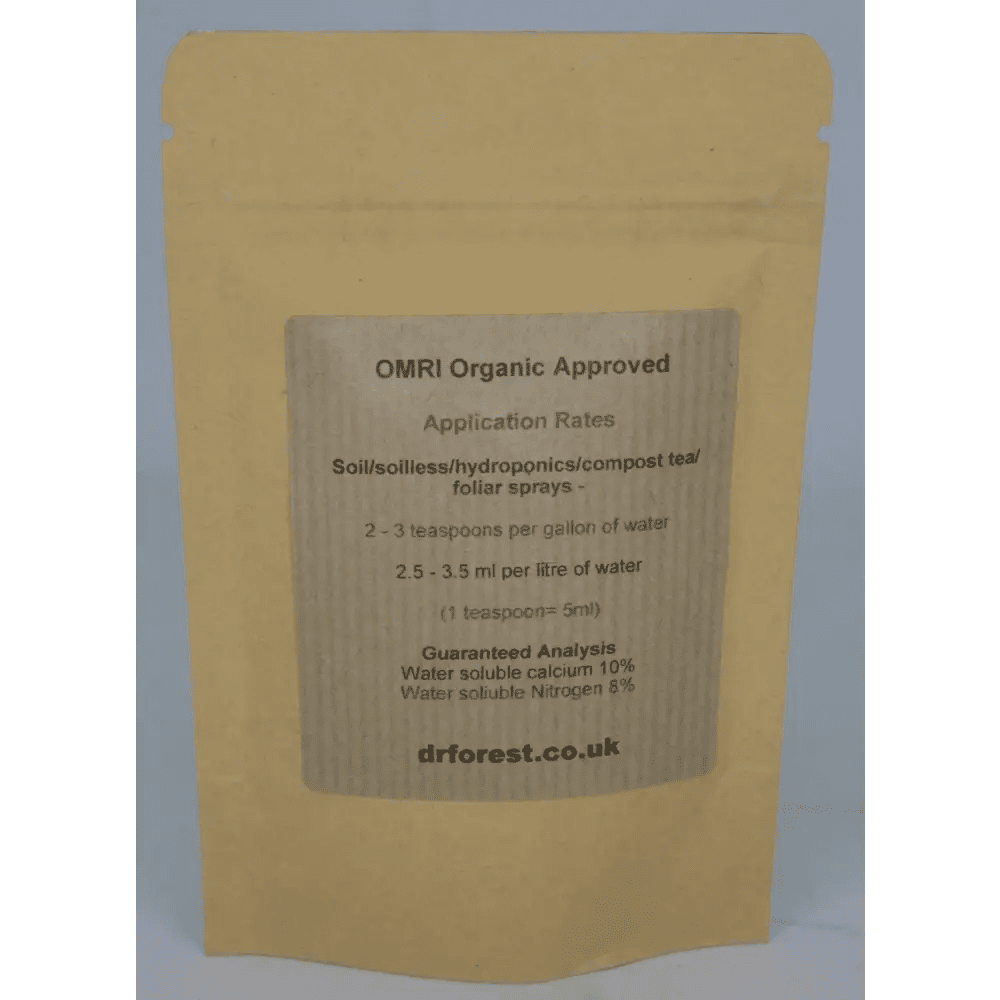
Cal-Mino is a fine, spray-dried powder that dissolves fully in water with no sediment or residue. Apply as a foliar spray, root drench, through fertigation or drip systems, or added to compost teas. No straining required. Use fresh solution within 24 hours. Half a level teaspoon is approximately 2.5 g.
Blossom end rot is set during early fruit development. Once the black patch appears, that fruit cannot be saved. Prevention is everything. Begin foliar calcium sprays when the first flowers open and continue weekly throughout fruiting. Consistent watering is equally important, because calcium transport depends on steady transpiration. Irregular watering is the single biggest trigger for blossom end rot, even in calcium-rich soil.
Dissolve in water and spray developing fruit and surrounding foliage in early morning or late evening. Target the fruit trusses directly: calcium needs to reach the fruit tissue, not just the upper leaves. Begin at first flower and continue throughout the fruiting period. This is the primary application for preventing blossom end rot in tomatoes, peppers, courgettes and aubergines.
Spray both leaf surfaces. Particularly useful for lettuce (tip burn prevention), brassicas, apples and soft fruit. Spray the tissue you want the calcium in; what lands on a leaf largely stays there.
Dissolve and apply to the root zone. Suitable for all container and bed-grown crops. The amino acid chelation helps keep calcium in solution in the soil, and the peptide base feeds soil biology.
Fully soluble with no residue, so it is safe for drip lines and recirculating feed systems. Add to the feed solution after mixing main nutrients. Perform a jar test before first use to confirm compatibility with your existing nutrient solution.
The amino acids and peptides feed microbial activity in the tea while the chelated calcium stays in solution.
| Situation | Rate | Frequency |
|---|---|---|
| Foliar spray, blossom end rot prevention | 2.5–3.5 g per litre | Weekly from first fruit set until harvest |
| Foliar spray, general calcium | 2.5–3.5 g per litre | Every 7–14 days in the growing season |
| Root drench, soil and containers | 2.5–3.5 g per litre | Every 2–4 weeks in the growing season |
| Solution feeding and fertigation | 2.5–3.5 g per litre | As part of the regular feed cycle |
| Compost tea | 2.5 g per litre of tea | Add during the brew cycle |
Use alongside Liquid Micronutrients for a combined calcium and trace element foliar programme. Combine with Seaweed Powder for biostimulant activity; the alginates help the spray wet the leaf. For soil-applied calcium alongside potassium and magnesium, use Yorkshire Polyhalite as the slow-release base and Cal-Mino as the fast-acting foliar top-up.
Keep the tub sealed, cool and dry. The powder draws moisture from the air and will cake if left open. Mixed solution should be used within 24 hours. Keep out of reach of children and pets, as with any concentrated feed.
Calcium in lime, gypsum or shell meal is a soil mineral. It works slowly in the soil and can't be sprayed onto a plant. Chelated calcium is held by another molecule, here amino acids from soy protein, so it dissolves completely in water and stays in solution. That means you can spray it onto the fruit and leaves that are short of calcium, rather than relying on the roots to move it there.
Dissolve 2.5–3.5 g per litre of water (half a level teaspoon is about 2.5 g) and use it the same day. As a spray, mist the young fruit, growing tips and both sides of the leaves in early morning or late evening, weekly from first fruit set for blossom end rot or every 7–14 days for general feeding. As a root drench, water it around the root zone every 2–4 weeks in the growing season. It also goes through drip lines and into compost tea at the same rate.
Spray it straight onto the tissue that needs it. Calcium moves up the plant with water and can't be passed from leaves to fruit, so a soil dressing can take weeks to show and may never reach a fast-swelling fruit. A soluble calcium sprayed on young fruit and growing tips gets there directly. Do it in cool, still conditions so the droplets stay wet long enough to soak in, and sort out uneven watering at the same time.
Tomatoes, peppers, courgettes and aubergines through fruiting, where it helps prevent blossom end rot on fruit that hasn't set yet. Lettuce and brassicas, where fast-growing inner leaves get tip burn. Apples and soft fruit, where calcium sprays on developing fruit are routine in commercial orchards. Because the solution is slightly acidic, it's also a calcium source for blueberries, rhododendrons and azaleas that won't lime the soil.
15% of buyers here also chose Cal-Mag for Plants
Adds calcium and magnesium for firm growth and fewer deficiencies.
from £10.49
An amino-acid foliar feed for quick uptake.
from £6.00


