




How Liquid Magnesium 21% Mg compares
Full guide and scienceLiquid Magnesium suspension (this product)
- Micronised magnesium carbonate, 21% Mg, in a fulvic acid carrier
- Carbonate particles dissolve gradually: one application feeds for weeks
- Shake, measure, dilute: 3–6 ml per litre foliar, 6–10 ml per litre drench
- Fulvic acid to help the magnesium into the leaf and the root
- Certified organic by ACO (input 456AI); no synthetic chelates, no animal by-products
Epsom salt (magnesium sulphate)
- Fully soluble, so the whole dose is available at once and moves with drainage water
- Needs weighing out and dissolving from dry each time
- Supplies sulphur as well as magnesium, which is useful where both are short
- More economical for bulk soil correction over large beds
- No carrier and no fulvic acid
Liquid magnesium fertiliser: a micronised suspension with fulvic acid
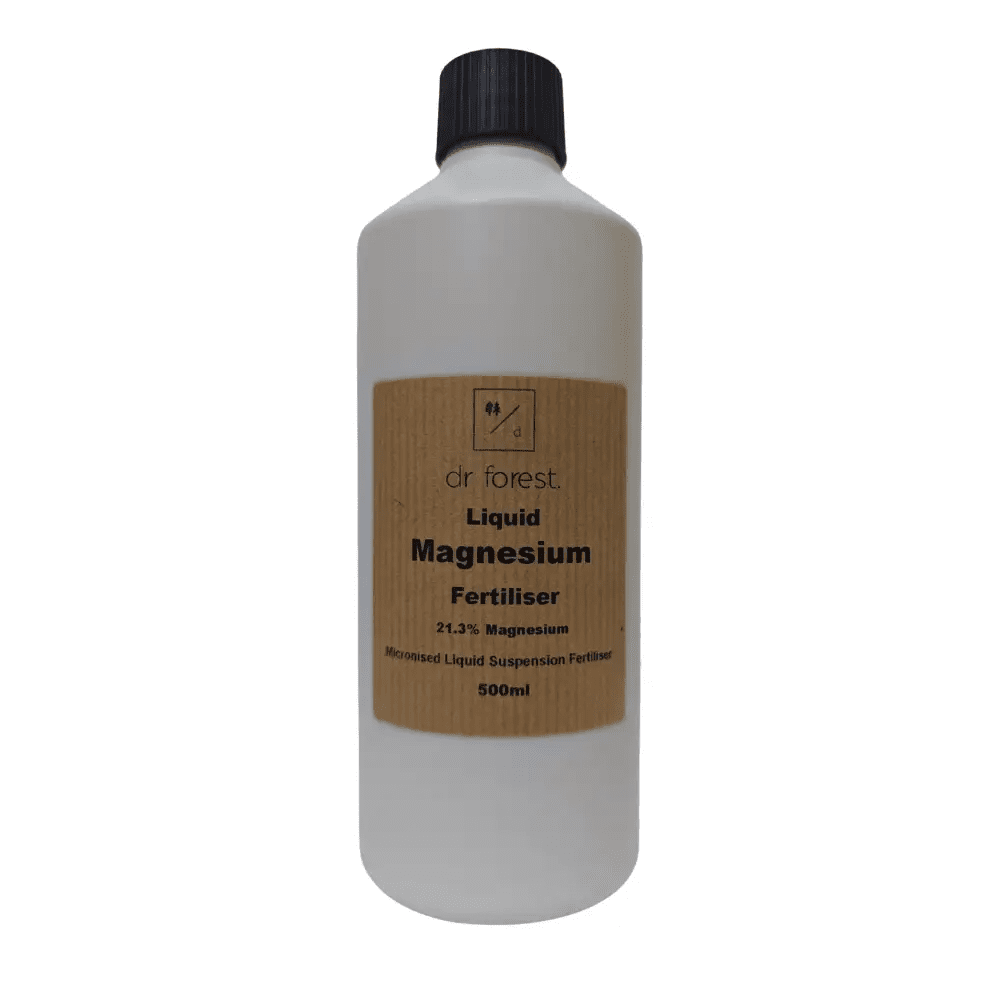
Dr Forest Liquid Magnesium is an organic liquid magnesium fertiliser: micronised magnesium carbonate held in suspension by fulvic acid, at 21% magnesium, ready to dilute for a foliar spray or a soil drench. The carbonate particles dissolve gradually in soil moisture rather than all at once, and the fulvic acid does two jobs: it keeps the mineral suspended in the bottle, and it helps carry magnesium into the leaf and through the root.
Magnesium is the atom at the centre of every chlorophyll molecule, so a plant short of it goes yellow between the veins (interveinal chlorosis), older leaves first. For bulk soil correction over whole beds, our granular Kieserite magnesium sulphate is the better fit.
What liquid magnesium is used for in the garden
- Magnesium deficiency in plants — a foliar spray puts magnesium straight onto the yellowing leaves; the directions below give a 7–14 day window for visible improvement.
- Tomatoes, peppers and other heavy fruiters in pots — high-potash feeding through fruiting pushes magnesium out of the uptake queue. A drench every 2–4 weeks keeps magnesium going in without cutting the potash.
- Roses and flowering shrubs — magnesium keeps the foliage dark green while the plant is putting its effort into flower. Read the evidence first in Epsom salt for roses: does it actually work?
- Light, sandy or acid soils — the soils most likely to run short, and the ones to keep topped up with a maintenance drench through the season.
- Small gardens and a few pots — measured in millilitres from the bottle, with no powder to weigh out and dissolve for a single can.
- Soil biology — every drench adds a little fulvic carbon to the root zone alongside the mineral.
Why a micronised suspension rather than Epsom salt?
Liquid Magnesium suspension (this product)
- Micronised magnesium carbonate, 21% Mg, in a fulvic acid carrier
- Carbonate particles dissolve gradually: one application feeds for weeks
- Shake, measure, dilute: 3–6 ml per litre foliar, 6–10 ml per litre drench
- Fulvic acid to help the magnesium into the leaf and the root
- Certified organic by ACO (input 456AI); no synthetic chelates, no animal by-products
Epsom salt (magnesium sulphate)
- Fully soluble, so the whole dose is available at once and moves with drainage water
- Needs weighing out and dissolving from dry each time
- Supplies sulphur as well as magnesium, which is useful where both are short
- More economical for bulk soil correction over large beds
- No carrier and no fulvic acid
Dr Forest is a small-batch fertiliser business in Stockport, Greater Manchester. This is a certified organic feed with no animal by-products, packed in recycled plastic. If your tomato leaves are already yellowing, start with our UK guide to magnesium deficiency in tomato plants to confirm the diagnosis before you spray. Made by Growers. Backed by Science.
The science of liquid magnesium: what the mineral and the carrier each do
What is in the bottle
Two functional ingredients. The first is magnesium carbonate, milled to a fine particle size so it stays in suspension and presents a large surface area to soil moisture. Carbonate is only sparingly soluble, which is the point: it releases magnesium a little at a time as the soil water around it turns over. The second is fulvic acid, the smallest, most mobile fraction of humic substances. In this product it is both the suspension carrier and a chelator for the magnesium.
Fulvic acid is a low-molecular-weight organic acid with plenty of acid groups that bind metal ions. The case for it as a carrier is that magnesium held in a fulvic complex should cross the waxy leaf cuticle and the root cell membrane more readily than a bare ion. The evidence we can cite for that is indirect, and it comes from the humic research under mechanism 06. If you want the longer version, read What is fulvic acid?
Composition and analysis
| Component | Value | Form |
|---|---|---|
| Magnesium (Mg) | 21% | Micronised magnesium carbonate, in suspension |
| Magnesium as oxide (MgO) | approx. 35% | Calculated from 21% Mg for comparison with bagged fertilisers |
| Fulvic acid | Carrier | Natural humic extract; suspension agent and chelator |
| Format | Liquid concentrate | Ready to dilute; recycled plastic bottle |
For scale, Kieserite is 25% MgO and Epsom salt about 16% MgO, both as soluble sulphate. This product goes on at millilitres per litre of water, and by the foliar route it bypasses the soil entirely.
Mechanisms of action
Magnesium sits at the centre of chlorophyll
Roughly 15–35% of the magnesium a plant absorbs is fixed in chlorophyll; the remainder goes to the vacuole and to protein synthesis, and magnesium is a cofactor for more than 300 enzymes involved in chlorophyll synthesis and carbon fixation (Ishfaq et al., 2022, Frontiers in Plant Science) [1]. Short the plant and it cannot build the pigment, which is why the leaf goes yellow.
Deficiency shows on old leaves first, and sugar backs up in the leaf
Magnesium is mobile in the plant, so when supply runs short the plant strips it out of mature leaves to feed new growth: interveinal chlorosis appears on older, fully expanded leaves and works upward as the deficiency deepens [1]. Sugars also pile up in the source leaves, a major consequence of magnesium shortage that most probably holds growth back by turning down photosynthesis (Verbruggen & Hermans, 2013, Plant and Soil) [2]. The same review notes that reliable markers for early deficiency are still hard to find, so the old-leaf yellowing remains the sign to go on.
Potassium antagonism, the container-tomato problem
Potassium, calcium, ammonium and sodium all compete with magnesium for uptake [1]. In a nutrient-solution trial on sugarcane, raising the potassium dose cut magnesium concentration in every plant part, roots most of all, and at very high potassium doses produced deficiency symptoms even where magnesium supply was adequate (Garcia et al., 2022, Plant and Soil) [3]. A tomato in a pot on a high-potash feed faces the same competition at the root.
Magnesium fertiliser pays, and most on the soils that need it
A meta-analysis of 570 paired observations from 99 field studies across ten countries found that magnesium fertilisation raised yield by a mean 8.5%, with fruit crops at 12.5% and vegetables at 8.9%. On soils with exchangeable Mg below 60 mg/kg the gain was 9.4%, roughly double the 4.9% seen on soils above 120 mg/kg (Wang et al., 2020, Frontiers in Plant Science) [4]. The analysis covered soil-applied magnesium only, so it tells you nothing about the spray.
Why magnesium goes missing from the soil
Magnesium is more mobile in soil than potassium, calcium or ammonium, and that mobility makes a soil test figure hard to translate into what the plant can actually take up (Gransee & Führs, 2013, Plant and Soil) [5]. The same review puts deficiency on acid soils down to acidity crowding magnesium off the soil's exchange sites so that it leaches away, and notes that sandy soils hold less magnesium than clays and silts to begin with. Guo et al. (2016, The Crop Journal) add the wider picture: magnesium has been the overlooked macronutrient, and the magnesium in cereal grain has declined over time [6].
Fulvic acid as the delivery vehicle
Nardi et al. (2002, Soil Biology and Biochemistry) review the evidence that the effect of humic substances depends in part on molecular size: the low-molecular-size fraction, below 3,500 daltons, reaches the plasma membrane of plant cells and is partly taken up, and it improves the uptake of some nutrients, nitrate in particular [7]. Canellas et al. (2015, Scientia Horticulturae) review the humic and fulvic biostimulant literature and report changes in roots and shoots linked to nutrient uptake, assimilation and distribution, promotion of lateral roots and shifts in metabolism related to abiotic stress tolerance [8].
We cannot show you a trial of this exact bottle against Epsom salt on a tomato in a pot. The literature above is the mechanism; the rates in the How to Use tab are the ones we recommend.
Scientific references
- Ishfaq, M., Wang, Y., Yan, M., Wang, Z., Wu, L., Li, C. & Li, X. (2022). Physiological essence of magnesium in plants and its widespread deficiency in the farming system of China. Frontiers in Plant Science, 13, 802274.
- Verbruggen, N. & Hermans, C. (2013). Physiological and molecular responses to magnesium nutritional imbalance in plants. Plant and Soil, 368, 87–99.
- Garcia, A., Crusciol, C.A.C., Rosolem, C.A., Bossolani, J.W., Nascimento, C.A.C., McCray, J.M., dos Reis, A.R. & Cakmak, I. (2022). Potassium-magnesium imbalance causes detrimental effects on growth, starch allocation and Rubisco activity in sugarcane plants. Plant and Soil, 472, 225–238.
- Wang, Z., Hassan, M.U., Nadeem, F., Wu, L., Zhang, F. & Li, X. (2020). Magnesium fertilization improves crop yield in most production systems: a meta-analysis. Frontiers in Plant Science, 10, 1727.
- Gransee, A. & Führs, H. (2013). Magnesium mobility in soils as a challenge for soil and plant analysis, magnesium fertilization and root uptake under adverse growth conditions. Plant and Soil, 368, 5–21.
- Guo, W., Nazim, H., Liang, Z. & Yang, D. (2016). Magnesium deficiency in plants: an urgent problem. The Crop Journal, 4(2), 83–91.
- Nardi, S., Pizzeghello, D., Muscolo, A. & Vianello, A. (2002). Physiological effects of humic substances on higher plants. Soil Biology and Biochemistry, 34(11), 1527–1536.
- Canellas, L.P., Olivares, F.L., Aguiar, N.O., Jones, D.L., Nebbioso, A., Mazzei, P. & Piccolo, A. (2015). Humic and fulvic acids as biostimulants in horticulture. Scientia Horticulturae, 196, 15–27.
How to use liquid magnesium: application rates and guide
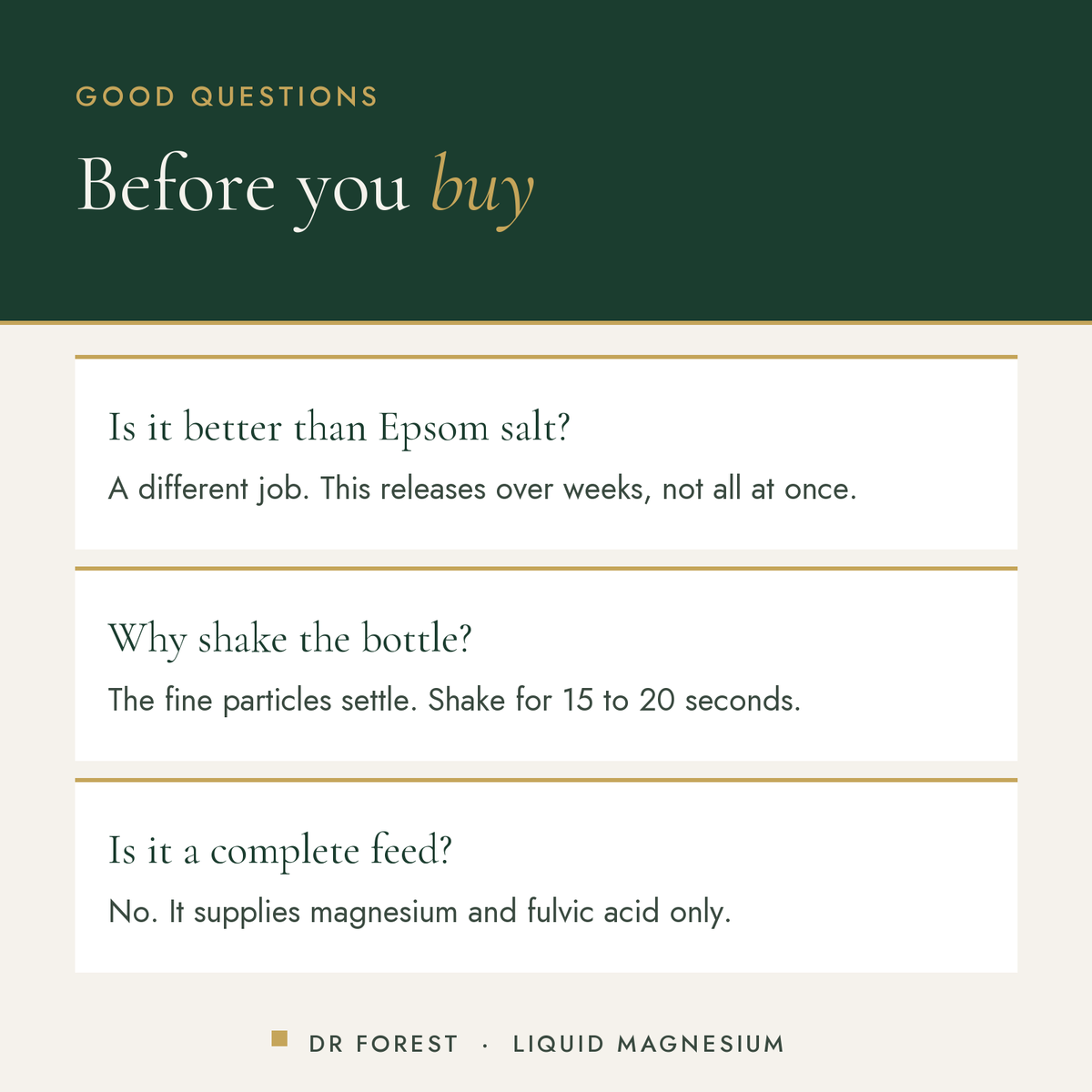
This is a mineral suspension, not a true solution. Shake the bottle vigorously for 15–20 seconds before each use. When diluting, add the concentrate to a small amount of warm water (20–30°C) first and stir well before adding the remaining water.
This bottle supplies magnesium and fulvic acid only. Keep using your main fertiliser alongside it. If the yellowing is on the young leaves rather than the old ones, it is probably not magnesium; check the diagnosis before you spray.
Application rates
Foliar spray
Apply as a fine mist to both leaf surfaces in early morning or late evening. Ensure thorough coverage including leaf undersides. The fulvic acid improves leaf cuticle penetration. Visible improvement in chlorosis typically appears within 7–14 days.
Soil drench, root zone application
Dilute and apply directly to the root zone. Water in afterwards. Use the higher rate (10 ml/L) for visibly deficient plants or known-low Mg soils. Use the lower rate for maintenance feeding.
Intensive correction, deficient crops
Combine foliar and root applications for fastest correction: foliar for immediate leaf response, root drench for sustained soil-level replenishment.
Rate table
| Situation | Rate | Per 10-litre can | Frequency |
|---|---|---|---|
| Foliar spray | 3–6 ml per litre of water | 30–60 ml | Every 2–4 weeks during the growing season |
| Soil drench, root zone | 6–10 ml per litre of water; the higher rate (10 ml/L) for visibly deficient plants or known-low Mg soils, the lower rate for maintenance feeding | 60–100 ml | Every 2–4 weeks during the growing season |
| Intensive correction, deficient crops | 10 ml per litre (soil) or 6 ml per litre (foliar) | 100 ml soil, 60 ml foliar | Every 2–3 weeks until symptoms resolve |
Step-by-step preparation
- Shake the bottle vigorously for 15–20 seconds. The particles settle during storage; thorough shaking is essential.
- Measure the concentrate. For a 10-litre watering can: 30–60 ml for foliar spray, or 60–100 ml for soil drench.
- Add to a small amount of warm water first (20–30°C) and stir well, then add the remaining water.
- Apply immediately. Foliar: fine mist to both leaf surfaces. Soil: evenly around the root zone.
- Store sealed between 5–25°C, away from direct sunlight. Shake before every use.
Pair with Seaweed Extract Powder in a foliar tank mix: alginic acid improves leaf wetting while fulvic acid helps uptake. Use alongside any Dr Forest crop-specific fertiliser where additional magnesium is needed. Combine with Amino Chelated Calcium for a foliar calcium and magnesium programme during fruiting. For bulk soil correction on beds and borders, Kieserite is the economical soluble option.
Keep the cap on tight and the bottle sealed between 5–25°C, out of direct sunlight. The mineral will settle to the bottom between uses; that is normal for a suspension and a good shake brings it back. Keep away from children and pets, and wash hands after handling.


