





How Liquid Micronutrients for Plants compares
Full guide and scienceMicro-7 chelated liquid
- Seven trace elements in one bottle and one pass with the watering can or sprayer
- Chelated, so the metals resist locking up on the leaf and in the soil
- Biodegradable chelating agent; no persistent synthetic EDTA
- Fulvic acid and saponins in the same bottle to help absorption and leaf wetting
Single-element sulphate salts (iron sulphate, zinc sulphate)
- You have to diagnose which element is short first
- Unchelated metals precipitate quickly on alkaline soil and become unavailable
- Correcting one element can suppress another
- Separate products at separate rates, which leaves more room for error
Customer highlight
As with every product from Dr Forest, the quality is excellent and this one is no exception. My plants are healthy ,vibrant green and show no signs of any trace element deficiency. Many thanks, Dr Forrest
Editorial highlight from marketplace and store reviews — separate from the full review list below.
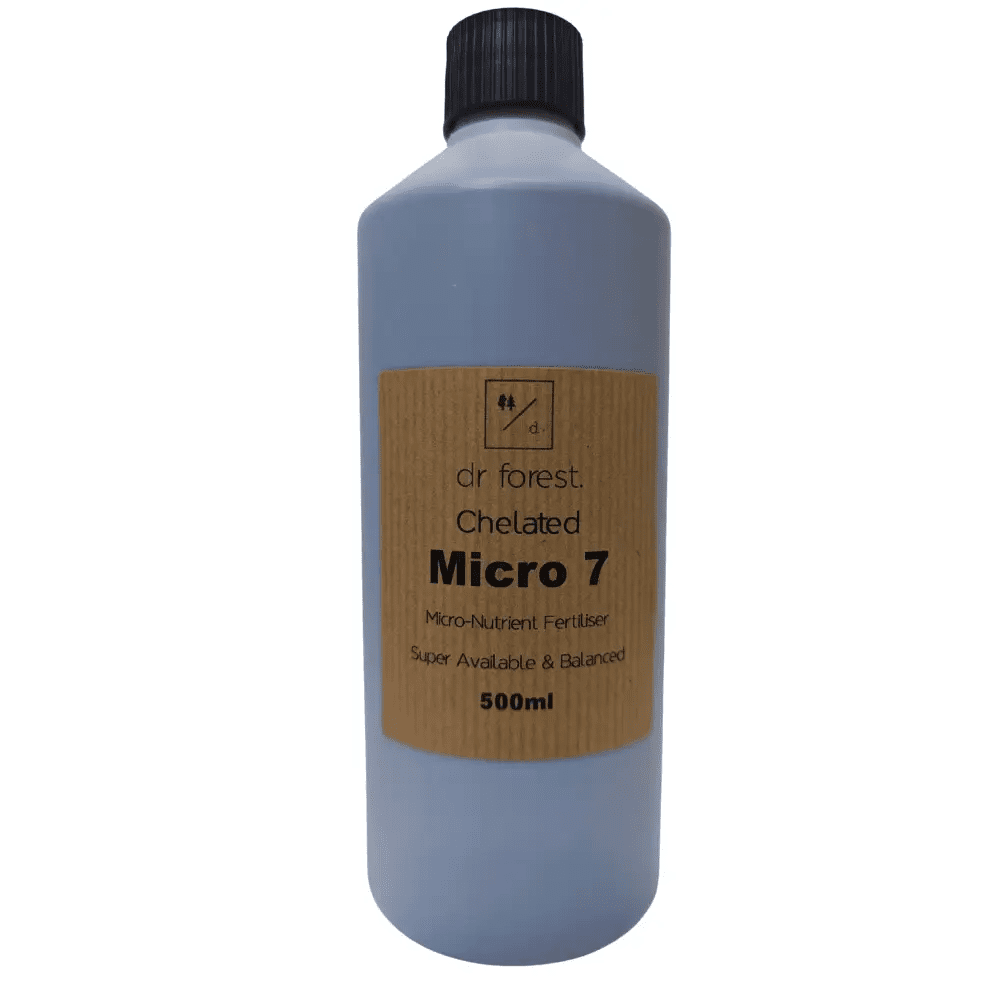
Liquid micronutrient fertiliser: seven trace elements in one bottle
Micro-7 is a liquid micronutrient fertiliser that supplies seven trace elements in a single concentrate: zinc, manganese, iron, copper, boron, molybdenum and cobalt. The metals (zinc, manganese, iron, copper) are chelated so they stay soluble and plant-available instead of locking up in the soil; boron, molybdenum and cobalt are included as soluble forms. Supplying the seven together lowers the risk of correcting one shortage and triggering another. The chelating agent is biodegradable, and the formula carries fulvic acid for uptake and natural saponins to help the spray wet the leaf.
It is a concentrated liquid for foliar spraying or soil drenching, made in small batches in Stockport, for vegetable plots, fruit trees, roses, ornamentals and lawns. It is a trace element supplement, not a complete feed, so use it alongside an NPK fertiliser such as All Purpose 4-4-4.
What liquid micronutrients are used for in the garden
- Correcting trace element shortages — yellowing young leaves with green veins, or small, distorted new growth: the usual signs of iron, manganese or zinc running short, especially on chalky or high-pH soil.
- Foliar feeding at flowering and fruit set — demand peaks in the reproductive stages, and a leaf spray gets trace elements in without waiting for the roots.
- Boron for pollination and fruit — boron supports pollen and the movement of sugars into developing fruit.
- Molybdenum and cobalt for legumes — peas and beans fix their own nitrogen only if the bacteria in their root nodules have the cofactors they need.
- Turf and ornamentals — iron and manganese for leaf colour across managed lawns and borders.
- Containers and peat-free compost — composts vary in trace element content, and a few light applications through the season cover the gaps.
Why a chelated seven-element liquid rather than single-element salts?
Micro-7 chelated liquid
- Seven trace elements in one bottle and one pass with the watering can or sprayer
- Chelated, so the metals resist locking up on the leaf and in the soil
- Biodegradable chelating agent; no persistent synthetic EDTA
- Fulvic acid and saponins in the same bottle to help absorption and leaf wetting
Single-element sulphate salts (iron sulphate, zinc sulphate)
- You have to diagnose which element is short first
- Unchelated metals precipitate quickly on alkaline soil and become unavailable
- Correcting one element can suppress another
- Separate products at separate rates, which leaves more room for error
Every bottle is packed in small batches at our workshop in Stockport. Not sure whether your plants need trace elements or something else? Start with what is a fertiliser, which covers all 17 essential nutrients.
The science of chelated micronutrients: why seven, and why chelated
Why trace elements run short
Plants need trace elements in tiny amounts, and a soil can hold plenty of a metal that the roots still cannot reach. Zinc, manganese, iron and copper all lock up as soil pH rises, which is why deficiencies cluster on chalky and heavily limed ground. Zinc deficiency is the most widespread micronutrient problem in world crops, with high pH, free lime and high phosphate among the soil factors behind it (Alloway, 2009). Manganese deficiency is common on dry, well-aerated, calcareous soils (Alejandro et al., 2020).
Composition
| Element | Content (% w/v) | Main job in the plant |
|---|---|---|
| Zinc (Zn) | 0.75% | Enzyme cofactor, leaf size, fruit set |
| Manganese (Mn) | 0.65% | Water-splitting in photosystem II |
| Iron (Fe) | 0.60% | Chlorophyll synthesis, electron transport |
| Copper (Cu) | 0.23% | Lignin and cell wall strength |
| Boron (B) | 0.16% | Pollen viability, sugar transport, cell walls |
| Molybdenum (Mo) | 0.02% | Nitrate reductase, nitrogen metabolism |
| Cobalt (Co) | 0.01% | Needed by nitrogen-fixing bacteria in legume nodules |
Also contains fulvic acid, natural saponins and carbohydrate-based microbial promotants. There is more on fulvic acid in what is fulvic acid. The blend is weighted towards zinc, manganese and iron. Boron and copper sit lower, and they are the two most likely to damage plants if overapplied.
Mechanisms of action
Trace metals compete with each other
A review of 94 studies covering 117 nutrient interactions found antagonistic effects on yield often among the divalent cations, a group that includes zinc, manganese, iron and copper (Rietra et al., 2017, Communications in Soil Science and Plant Analysis). Dose one heavily on its own and uptake of the others can drop. That is the case for a balanced blend over a single-element salt.
Iron chlorosis on chalky soil
On calcareous soil, chlorotic leaves often hold more iron than green ones; the trouble is getting it into the cells. Bicarbonate neutralises the acid the plant pumps out and suppresses the reduction step it needs before iron can be taken in (Mengel, 1994, Plant and Soil). What a chelate does is keep the iron in solution; unchelated iron drops out as insoluble oxide once the pH climbs.
A chelate that breaks down
EDTA is effective but recalcitrant: biodegradation plays only a minor part in its environmental fate and it persists (Bucheli-Witschel and Egli, 2001, FEMS Microbiology Reviews). The chelating system in Micro-7 holds the metal in solution while it is active, then breaks down in the soil rather than accumulating.
Saponins help the spray wet the leaf
Foliar uptake depends on the droplet spreading and staying liquid long enough to cross the cuticle. On isolated tomato fruit cuticles, adding a surfactant raised calcium chloride penetration at 48 hours from 40% to 56%, by spreading the droplet and delaying drying (Tredenick et al., 2018, Frontiers in Plant Science). That surfactant was ethoxylated rapeseed oil. Saponins are natural surfactants from plants, and we have not seen them tested the same way. Uptake needs the droplet to stay wet, which is why the directions say to spray in the cool of the morning or evening.
Molybdenum and cobalt for nitrogen fixation
Nitrate reductase, the enzyme that processes the nitrate a plant takes up, needs molybdenum to work, so a shortage holds back nitrogen metabolism (Kaiser et al., 2005, Annals of Botany). In legumes, iron and molybdenum limitation inside the nodule is common even in soils with enough of both, because the nodule interior is acidic and low in oxygen (Bonilla and Bolaños, 2009). Nodulated legumes also show a higher cobalt demand than non-nodulated ones, though how often soil cobalt actually limits them is unclear. The evidence for cobalt is thinner than for the other six.
Why the rate cap matters: boron toxicity is real
Boron-rich soils cause boron toxicity and lower crop yields, and the toxicity is hard to diagnose from visible symptoms or tissue tests (Nable et al., 1997, Plant and Soil). Micro-7 carries 0.16% boron, and the directions cap applications at six a year unless a soil or tissue test shows an ongoing need.
For zinc specifically, including its link to flavour and aroma in herbs, see zinc deficiency in plants.
Scientific references
- Alloway, B.J. (2009). Soil factors associated with zinc deficiency in crops and humans. Environmental Geochemistry and Health, 31(5), 537–548.
- Alejandro, S., Höller, S., Meier, B. and Peiter, E. (2020). Manganese in plants: from acquisition to subcellular allocation. Frontiers in Plant Science, 11, 300.
- Rietra, R.P.J.J., Heinen, M., Dimkpa, C.O. and Bindraban, P.S. (2017). Effects of nutrient antagonism and synergism on yield and fertilizer use efficiency. Communications in Soil Science and Plant Analysis, 48(16), 1895–1920.
- Mengel, K. (1994). Iron availability in plant tissues: iron chlorosis on calcareous soils. Plant and Soil, 165(2), 275–283.
- Bucheli-Witschel, M. and Egli, T. (2001). Environmental fate and microbial degradation of aminopolycarboxylic acids. FEMS Microbiology Reviews, 25(1), 69–106.
- Tredenick, E.C., Farrell, T.W. and Forster, W.A. (2018). Mathematical modeling of diffusion of a hydrophilic ionic fertilizer in plant cuticles: surfactant and hygroscopic effects. Frontiers in Plant Science, 9, 1888.
- Kaiser, B.N., Gridley, K.L., Brady, J.N., Phillips, T. and Tyerman, S.D. (2005). The role of molybdenum in agricultural plant production. Annals of Botany, 96(5), 745–754.
- Bonilla, I. and Bolaños, L. (2009). Mineral nutrition for legume-rhizobia symbiosis: B, Ca, N, P, S, K, Fe, Mo, Co, and Ni: a review. In: Lichtfouse, E. (ed.) Sustainable Agriculture Reviews, vol. 1. Springer, Dordrecht, 253–274.
- Nable, R.O., Bañuelos, G.S. and Paull, J.G. (1997). Boron toxicity. Plant and Soil, 193(1), 181–198.
How to use Micro-7: application rates and guide
Shake or stir well before use. Measure with a syringe or graduated cap; the home-garden dose is 7.5 ml into a 9-litre watering can, and small errors matter with trace elements. Mix fresh for each application.
Micro-7 is a concentrated chelated micronutrient blend. More is not better. Excessive application of trace elements, particularly boron and copper, can cause phytotoxicity. Follow the rates below and do not apply more than 6 times per year without a demonstrated trace element requirement from soil or tissue testing. Micro-7 provides trace elements only. It does not replace macronutrient (NPK) feeding.
Application rates: home garden
Foliar spray and soil drench, standard rate
Dilute 7.5 ml of Micro-7 into a 9-litre watering can of water. For foliar spraying, apply as a fine mist to both leaf surfaces in early morning or late evening. For soil drenching, apply the diluted solution evenly over the root zone at 1 litre per square metre. This rate can be used for both foliar and soil application.
Application frequency
Apply at key growth stages: pre-flowering, flowering, fruit set and fruit fill. Most garden crops benefit from 3–4 applications per season. Leafy vegetables and high-demand fruiting crops may warrant up to 6 applications. Do not exceed 6 applications per year without soil or tissue test confirmation of ongoing deficiency.
Best timing
Micronutrient demand peaks during the reproductive stages: flowering, pollination, fruit set and fruit development. Apply the first dose as flower buds begin forming and repeat at each subsequent stage. Early-season applications support vegetative establishment; late-season applications improve fruit quality and storage life.
Application rates: professional and commercial
| Situation | Rate | Frequency |
|---|---|---|
| Foliar spray, vegetables | 5 ml per litre of water (0.5 L per 100 L); max 2.5 L/ha | Every 2 weeks or as required |
| Foliar spray, orchards and vineyards | 5 ml per litre of water (0.5 L per 100 L); max 5 L/ha | Every 2–4 weeks or as required |
| Foliar spray, ornamentals and turf | 5 ml per litre of water (0.5 L per 100 L); max 2.5 L/ha | Every 2–4 weeks or as required |
| Broadacre crops | 2–3 L/ha in 60–100 L water | As required by crop monitoring |
| Fertigation and soil amelioration | 10–30 L/ha | As required |
| Spot spraying, individual plants and small areas | 2.5 ml per litre of water | As required |
Notes on the commercial rates
Vegetables: target pre-flower, flowering, fruit set and fruit fill stages. Ensure thorough coverage of all foliage. Where higher water volumes are needed for canopy penetration, do not exceed the maximum product rate per hectare.
Orchards and vineyards: time applications to pre-flower, flowering and fruit fill stages for the greatest effect on fruit quality, set and shelf life.
Ornamentals and turf: for colour intensity and overall plant vigour in managed landscapes and sports turf.
Broadacre: adjust water volume depending on canopy closure. Apply at key growth stages: tillering, stem extension, pre-flower and grain fill for cereals; pre-flower and pod fill for legumes.
Fertigation and soil amelioration: use the higher rate for soil amelioration where multiple trace element deficiencies have been identified through soil testing. Use the lower rate for maintenance fertigation through drip systems. Maintain minimum 1:3 dilution ratio (product to water).
Spot spraying: for targeted foliar application to individual plants or small problem areas. Apply as a fine mist to both leaf surfaces. Suited to visible deficiency symptoms on specific plants without spraying the entire crop.
Step-by-step preparation
- Shake the bottle well. The product contains suspended components that settle during storage. Shake vigorously for 15–20 seconds before measuring.
- Measure 7.5 ml. Use a measuring syringe or graduated cap. For a 9-litre watering can, 7.5 ml is the standard dose.
- Add to water and stir. Add the measured product to the watering can and stir briefly. The chelated nutrients dissolve readily.
- Apply as foliar spray or soil drench. For foliar, use a sprayer targeting both leaf surfaces. For soil drench, pour evenly at 1 litre of diluted solution per m². Maintain agitation during sprayer use.
- Spray in cool conditions. Apply in early morning or late evening. Temperature below 30°C, low wind and high humidity give the best foliar absorption. Avoid full sun, as the solution dries too fast.
Chelated metals can irritate skin and eyes. Wear gloves, eye protection and long sleeves when mixing and applying. Wash hands and exposed skin thoroughly after use. Keep out of reach of children and pets.
Use Micro-7 alongside a Dr Forest crop-specific fertiliser for complete nutrition: Organic Tomato Fertiliser 3-4-6 for tomatoes and other fruiting veg, Organic Rose & Shrub Fertiliser 5-3-5 for roses and flowering shrubs, Fruit & Vegetable Fertiliser 4-5-6 or All Purpose 4-4-4 for the rest of the plot. Pair with Seaweed Extract Powder for additional biostimulant activity. Avoid tank-mixing with concentrated calcium or phosphate solutions, and do a jar test before combining with any new product.
Store in a cool, dry place above 5°C, out of direct sunlight, with the cap sealed. Below 5°C, crystallisation or sedimentation may occur; warm gently and shake if this happens.
Frequently asked questions about liquid micronutrients
Zinc 0.75%, manganese 0.65%, iron 0.60%, copper 0.23%, boron 0.16%, molybdenum 0.02% and cobalt 0.01% (all w/v). It also contains fulvic acid, natural saponins and carbohydrate-based microbial promotants.
No. It's a trace element supplement, so use it alongside an NPK fertiliser such as All Purpose 4-4-4.


