
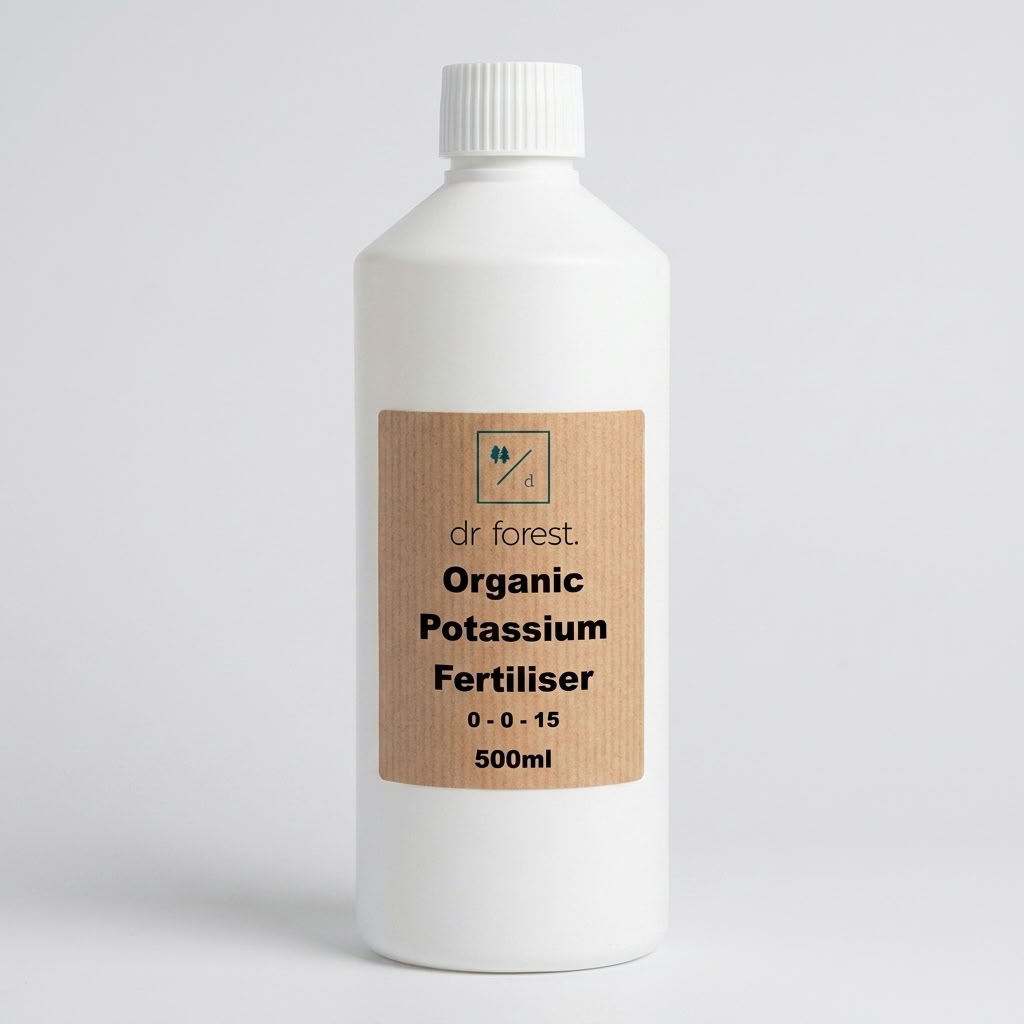
Organic liquid potassium fertiliser: 15% K₂O, fully in solution
Liquid potassium fertiliser is a concentrated potash feed that delivers 15% K₂O already dissolved in solution, so the potassium is available to the plant the moment it reaches the root or the leaf. Potassium is the nutrient that moves sugars out of the leaf and into fruit, and it governs how a plant manages water under heat and drought. It is plant-derived rather than mined, with the feedstock drawn partly from agricultural residual streams.
It behaves nothing like a mineral suspension. There is no settling, no shaking, and no grit to clog a sprayer nozzle or a dosing line. The potassium is genuinely dissociated in solution, held alongside 27% organic matter that carries plant-derived carbon into the root zone with every dose. That figure is high enough to mean something for soil biology and low enough that it will not block an irrigation system.
This is a single-nutrient feed. It carries no nitrogen and no phosphorus, so you control potassium independently of everything else in the programme, which is exactly what a fruiting crop needs in its second half.
What to use liquid potash for
- Tomatoes, peppers, chillies and aubergines from first fruit set. Potassium demand climbs sharply once fruit starts filling. This is the classic high-potash tomato feed application, and the point in the season where a dedicated potassium source earns its place
- Strawberries, raspberries, currants and top fruit during fruit development. Potassium drives the movement of sugars from leaf to fruit. Berry crops respond in soluble solids and in the sugar-to-acid balance that determines how a fruit actually tastes
- Potatoes from flowering through to lifting. One of the highest potassium-demanding crops in the vegetable garden. Apply from first bloom onwards
- Roses, dahlias and herbaceous borders in late season. Potassium stiffens stems and supports repeat flowering. Useful through the second half of the growing season when nitrogen should be tapering off
- Correcting visible potassium deficiency. Scorched, browning leaf margins on older leaves, working inward from the edge. A foliar application is the fastest route to correcting it
- Heat and drought resilience. Potassium regulates stomatal opening, which is how a plant controls water loss. Plants short of potassium wilt sooner and recover more slowly
- Drip lines and dosing systems. Fully in solution with no settling, so it feeds through irrigation equipment without the clogging a mineral suspension causes
Liquid potash compared with the alternatives
Liquid potassium 15% K₂O
- Potassium fully in solution, taken up on contact with no dissolution lag
- 27% organic matter carries plant-derived carbon into the root zone
- Works as a root drench or a foliar spray from the same bottle
- Plant-derived rather than mined, partly from agricultural residual streams
- No settling, so it runs clean through a sprayer, a dosing pump or a watering can
- Single nutrient, so potassium is controlled independently of N and P
Sulphate of potash (SOP)
- A sound mineral choice, and genuinely chloride-free
- Dry crystalline salt, so it needs dissolving and dissolves slowly in cold water
- Supplies sulphur alongside potassium, which is often useful
- No organic matter and no carbon contribution
- Mined or manufactured rather than plant-derived
Muriate of potash (KCl)
- The cheapest source of potassium per kilogram, which is why it is so widely used
- Roughly 47% chloride by weight, which accumulates in containers and grow bags
- No organic matter, no carbon contribution to soil biology
- Adequate in open ground on chloride-tolerant crops
This is a single-nutrient feed. It carries no nitrogen and no phosphorus, which is exactly what you want in the second half of a fruiting crop, because late nitrogen pushes leaf at the expense of fruit. Run it alongside a balanced base feed early in the season, then lean on it as the crop fills.
Made with organic ingredients. Made by Growers. Backed by Science.
The science of potassium in plants
Potassium is the odd one out among the major nutrients. Nitrogen ends up in protein, phosphorus in DNA and membranes, calcium in cell walls. Potassium is built into almost nothing. It stays as a free ion in solution inside the plant, and it is the most abundant cation in plant tissue, which tells you its job is regulatory rather than structural (Marschner, 2012).
Potassium is not what the plant is made of. It is how the plant runs itself.
What potassium actually does
Stomatal regulation and water use
Guard cells open and close by pumping potassium in and out, which changes their turgor. A plant short of potassium loses fine control over its stomata, wastes water on hot days and shuts down photosynthesis sooner under drought stress (Hasanuzzaman et al., 2018).
Phloem loading, moving sugar to fruit
Sucrose transport from leaf to sink tissue is driven by a proton gradient that depends on potassium. This is the direct mechanistic link between potassium supply and fruit sugar content, and it is why potash feeds change how fruit tastes rather than only how large it grows (Zörb et al., 2014).
Enzyme activation
More than sixty plant enzymes require potassium as an activator, including those in starch synthesis and nitrogen assimilation (Marschner, 2012). Potassium shortage therefore reduces the plant's ability to use the nitrogen it has already taken up.
Osmotic adjustment under stress
Potassium accumulation in the vacuole lowers cell water potential, letting roots keep drawing water from drying soil. Well-supplied plants hold turgor longer into a dry spell.
Stem strength and lodging resistance
Potassium supports lignification and cell wall thickening in stem tissue. Deficient plants are visibly floppier and lodge more readily.
Solution versus suspension
A great deal of what is sold as liquid fertiliser is a suspension: solid mineral particles held in water. Those products settle, need agitating, and have to dissolve in the soil before a root can take anything up. This feed is a true solution. The potassium is already dissociated as K⁺, which is the only form a root hair or a leaf cuticle can absorb. There is no dissolution step to wait for.
That is what makes the same bottle work as a foliar spray. Foliar uptake happens through cuticular pores measured in nanometres. A suspended particle cannot pass, but an ion in solution can. It is also why it runs through drip lines and dosing equipment without blocking them.
Potassium and magnesium compete
Potassium, magnesium and calcium are all taken up as cations and they compete for the same root uptake sites. Sustained heavy potash feeding can therefore induce magnesium deficiency even where soil magnesium is adequate, showing as interveinal yellowing on older leaves. This is the single most common self-inflicted problem in a long high-potash tomato season, and the reason a calcium and magnesium source belongs in the programme alongside a potash feed rather than after it.
Chloride and the source of your potash
Chloride is a micronutrient, so plants need a little. The problem is dose. Muriate of potash is close to half chloride by weight, so a season of potash feeding in a container can deliver chloride well beyond the micronutrient requirement. Chloride is highly mobile and osmotically active, so it raises the salt load of the root zone and competes with nitrate uptake at the root surface (Xu et al., 2000). In open ground on free-draining soil, winter rainfall flushes it out. In a grow bag or a 10-litre pot, it does not. Tomatoes, strawberries, potatoes and beans are the crops where chloride sensitivity shows earliest, which is unfortunate, because those are also the crops gardeners feed the most potash to. It is worth knowing which potassium source you are actually using.
Plant-derived rather than mined
The potassium here is plant-derived, with the feedstock drawn partly from agricultural residual streams. Conventional potash is mined, refined and freighted a long way before it reaches a British garden. Plant-based nutrient sources avoid that entirely, and the literature on bio-based fertilisers describes them as a credible route to reducing the extraction footprint of fertiliser production (Chojnacka et al., 2020).
One honest consequence: because the feedstock is natural plant material, the nutrient content varies slightly between batches. The 15% figure is the specification, not a laboratory constant.
References
- Marschner, P. (ed.) (2012). Marschner's Mineral Nutrition of Higher Plants, 3rd edition. Academic Press.
- Hasanuzzaman, M. et al. (2018). Potassium: a vital regulator of plant responses and tolerance to abiotic stresses. Agronomy, 8(3), 31.
- Zörb, C., Senbayram, M. & Peiter, E. (2014). Potassium in agriculture: status and perspectives. Journal of Plant Physiology, 171(9), 656–669.
- Xu, G., Magen, H., Tarchitzky, J. & Kafkafi, U. (2000). Advances in chloride nutrition of plants. Advances in Agronomy, 68, 97–150.
- Chojnacka, K. et al. (2020). Bio-based fertilizers: a practical approach towards circular economy. Bioresource Technology, 295, 122223.
How to use liquid potassium fertiliser
Shake gently and measure with a syringe or a small measuring cup, because at these dilutions a splash from the bottle is a long way off the mark. The feed is acidic at pH 5 to 6, which is normal and helps keep the potassium mobile. Always mix into water and never apply neat to soil or foliage. Before a first foliar application, spray two or three leaves and leave them 24 hours to check the plant is happy with the rate.
Application rates
Root drench, main season feeding
Delivers roughly 180 to 390 mg/l of K₂O, a proper high-potash feeding concentration comparable to a commercial tomato feed. Use the lower end for general border and container feeding, the upper end for heavy fruiting crops from first fruit set onwards.
Foliar spray, fast correction
Spray to run-off in the early morning or evening, never in strong sun. The fastest route to correcting visible potassium deficiency, and useful as a top-up when roots are struggling in cold or waterlogged soil.
Light maintenance feed
For established perennials, shrubs and anything already on a balanced base feed that needs only a potassium top-up rather than a full high-potash programme.
Mixing
- Half-fill the watering can or sprayer with water first. Never add the concentrate to an empty container.
- Measure the dose with a syringe or measuring cup and add it to the water.
- Top up to the full volume and stir or agitate briefly.
- Apply the same day. Diluted feed is not worth keeping.
- Rinse the sprayer through with clean water afterwards.
When to apply through the season
| Crop | When to apply |
|---|---|
| Tomatoes, peppers, aubergines | After fruit set, then weekly through fruit development |
| Strawberries and cane fruit | From flowering through fruit development |
| Potatoes | First application at bloom, then through to lifting |
| Top fruit, apples, pears, plums | Through fruit development, tapering off 4 weeks before harvest |
| Roses and herbaceous borders | Late growth stage, from midsummer onwards |
| Ornamentals and container displays | Late growth stage, weekly to keep flowering going |
Potassium competes with magnesium and calcium for uptake at the root. Heavy, sustained potash feeding can induce magnesium deficiency, seen as interveinal yellowing on older leaves, even where soil magnesium is adequate. If you are feeding hard with potash through a long tomato season, keep an eye on the lower leaves and run a magnesium or calcium source alongside.
Storage
Keep the cap tight. Store somewhere dark and dry between 10 and 25 °C. Shelf life is 18 months to 2 years from bottling. Do not let it freeze.
What to pair it with
Pair this with the rest of the Dr Forest liquid range. Liquid Gypsum supplies the calcium and sulphur that most liquid feeds leave out, and is the natural partner here given how hard potassium competes with calcium at the root. Liquid Seaweed Biostimulant covers alginates and natural growth promoters that a straight nutrient feed does not. Micro 7 chelated micronutrients fills the trace element gap on long cropping runs. For a full-season plan, see the Dr Forest feeding programme.


