
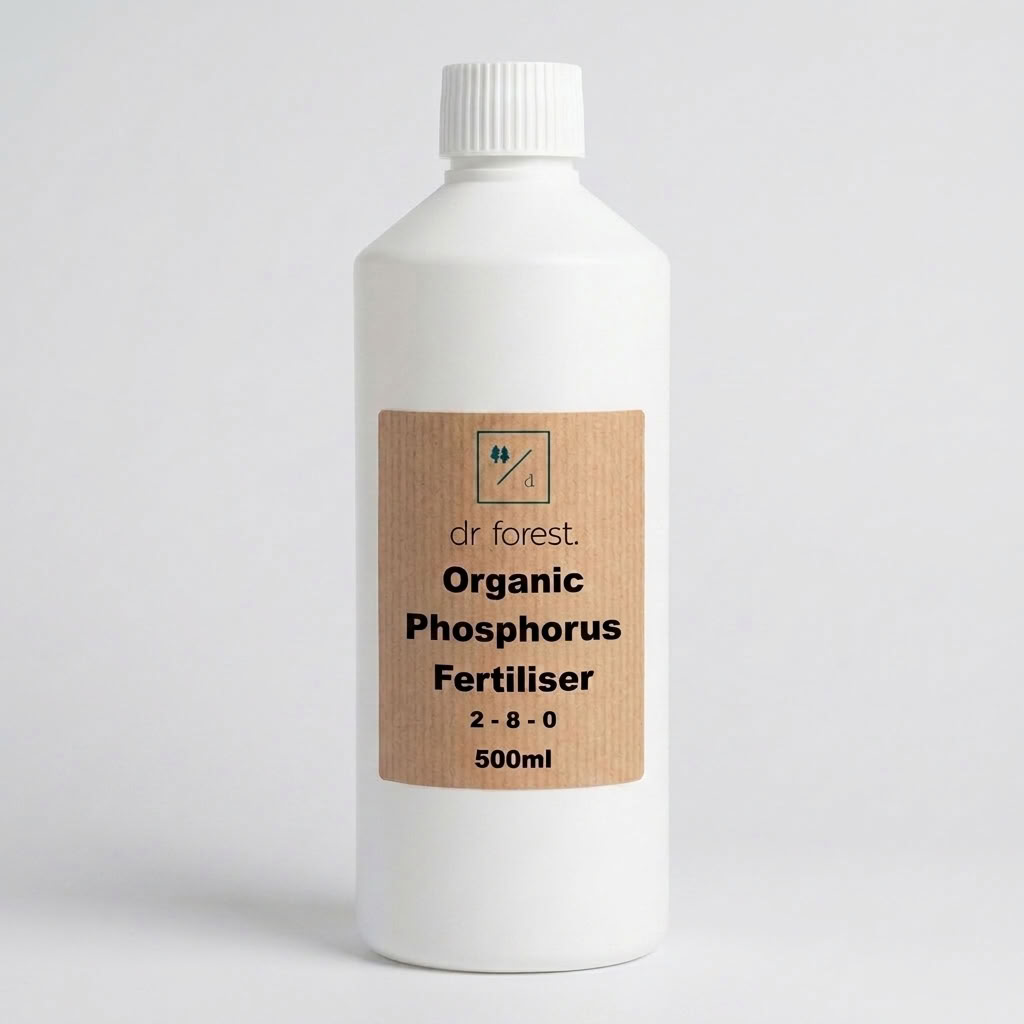
How Organic Phosphorus Fertiliser compares
Full guide and scienceLiquid phosphorus 8% P₂O₅
- Already in solution — no dissolution step, no waiting on soil chemistry
- Low organic matter, so it runs clean through drip lines and sprayers
- Applied little and often to the root zone, where fixation losses are lowest
- Plant-derived rather than mined or manufactured
- Acidic at pH 3.5 to 4.5, which helps keep phosphate mobile at the root surface
Rock phosphate and bone-based meals
- Very slow release — measured in seasons rather than weeks
- Useful for building long-term soil phosphorus reserves
- Bone-derived products are animal by-products; Dr Forest does not use them
- Little use for correcting an active deficiency in a growing crop
Organic liquid phosphorus fertiliser — 8% P₂O₅ plant-available phosphate feed
Liquid phosphorus fertiliser supplies 8% P₂O₅ already dissolved in solution, which sidesteps the single biggest problem with phosphorus in the garden: most of the phosphate applied to soil never reaches a root. Phosphorus is the least mobile of the major nutrients, and in British soils it locks up rapidly — bound to calcium on chalky ground, to iron and aluminium on acid ground. Applying it in solution, low, little and often, puts phosphate where roots are actively working rather than leaving it to be fixed in the wider soil volume.
Phosphorus is what a plant runs on rather than what it builds with. It is in every molecule of ATP, in the phospholipids of every cell membrane and in the backbone of DNA. Shortage shows up first as a plant that simply does not get going — small, dark, sometimes purple-tinged, rooting badly and flowering late.
The organic matter content is deliberately low at 9%, which keeps the solution thin and clean. It passes through drip lines, dosing pumps and fine sprayer nozzles without the residue that heavier organic feeds leave behind.
What to use liquid phosphate for
- Establishing transplants and young plants — the period of highest phosphorus demand in the whole life of a plant. Root initiation and early cell division are both phosphorus-hungry, and a seedling checked at this stage rarely fully catches up
- Root development on cuttings, plugs and bare-root stock — phosphorus drives root branching and fine root production. Apply from the point roots first appear and through the following five to six weeks
- Flower initiation and fruit set — the transition from vegetative growth to flowering runs on phosphorus. A feed in the run-up to and through bud formation supports set rather than drop
- Cold spring soils — phosphorus uptake falls sharply below about 12 °C because root activity and mycorrhizal function both slow. A liquid feed bypasses the soil chemistry when the ground is still cold
- Correcting phosphorus deficiency — stunted growth, unusually dark or dull green foliage, purpling on stems and the undersides of older leaves, delayed flowering
- Chalky and very alkaline soils — where applied phosphate is quickly bound as insoluble calcium phosphate. Small, frequent liquid doses to the root zone are far more efficient than bulk applications
- Potatoes and root crops during tuber development — especially on light sandy soils and towards the end of the vegetative stage
Liquid phosphate compared with the alternatives
Liquid phosphorus 8% P₂O₅
- Already in solution — no dissolution step, no waiting on soil chemistry
- Low organic matter, so it runs clean through drip lines and sprayers
- Applied little and often to the root zone, where fixation losses are lowest
- Plant-derived rather than mined or manufactured
- Acidic at pH 3.5 to 4.5, which helps keep phosphate mobile at the root surface
Rock phosphate and bone-based meals
- Very slow release — measured in seasons rather than weeks
- Useful for building long-term soil phosphorus reserves
- Bone-derived products are animal by-products; Dr Forest does not use them
- Little use for correcting an active deficiency in a growing crop
Superphosphate and triple superphosphate
- Fast-acting mineral phosphate, manufactured by acidulating rock phosphate
- Highly prone to fixation when broadcast across soil rather than placed
- No organic matter and no carbon contribution
- Derived from a finite mined resource with a well-documented supply horizon
Phosphate and calcium react in solution to form insoluble calcium phosphate. If you combine this feed with a calcium product — liquid gypsum, liquid calcium, or hard tap water treated with a calcium supplement — you will get a white precipitate, a blocked sprayer and no phosphorus reaching the plant. Apply calcium and phosphorus on separate waterings, at least a day apart.
Blended and bottled in small batches in Stockport, Greater Manchester. Plant-based throughout, with no slaughterhouse by-products at any stage. Made by Growers. Backed by Science.
The science of phosphorus in plants and soil
Phosphorus is the nutrient gardeners most often apply and least often deliver. Estimates of the proportion of applied phosphate taken up by a crop in the year of application sit between 10% and 25%. The rest is fixed into forms plants cannot reach (Hinsinger, 2001; Shen et al., 2011).
Phosphorus in soil is rarely absent. It is usually present and unavailable.
Why phosphate locks up
Phosphate is an anion with a strong affinity for metal cations. Above about pH 7 it precipitates with calcium as increasingly insoluble calcium phosphates. Below about pH 5.5 it binds to iron and aluminium oxides. The window of maximum availability is narrow — roughly pH 6 to 7 — and even inside it, phosphate moves through soil by diffusion alone, at rates measured in millimetres. A root does not find phosphate; phosphate has to be within a millimetre or two of a root hair.
What phosphorus does inside the plant
Energy transfer
Every energy transaction in a plant cell runs through ATP, and the phosphate groups are the energy carrier. Photosynthesis, nutrient uptake and every biosynthetic pathway depend on it (Marschner, 2012).
Cell membranes
Phospholipids form the bilayer of every membrane in the plant. Cell division cannot proceed without phosphorus, which is why deficiency shows as stunting rather than as a colour change on new growth.
Nucleic acids
Phosphate forms the structural backbone of DNA and RNA. Rapidly dividing tissue — root tips, shoot meristems, developing seed — has the highest demand.
Root architecture
Phosphorus availability directly shapes root branching. Under moderate shortage plants invest in more, finer roots to forage; under severe shortage the whole root system is smaller (Shen et al., 2011).
Flowering and seed set
The shift from vegetative growth to reproduction carries a step change in phosphorus demand. Deficient plants flower late and set poorly.
Mycorrhizal partnership
Most garden plants acquire a large share of their phosphorus through mycorrhizal fungi, which extend the effective root surface many times over. Very heavy phosphate applications suppress that association (Smith & Read, 2008).
Why liquid, and why little and often
Fixation is a function of contact between phosphate and soil. Broadcasting dry phosphate across a bed maximises that contact and therefore maximises loss. Delivering a dilute solution directly into the root zone at intervals does the opposite: the phosphate arrives where roots are already working, in a form they can take up immediately, in a quantity small enough to be absorbed before the soil claims it.
The acidity helps. At pH 3.5 to 4.5 the applied solution briefly lowers pH in the immediate root zone, which is the same trick roots themselves use — root exudation of organic acids to solubilise bound phosphate is a well-described mechanism (Hinsinger, 2001).
A finite resource, and a plant-derived alternative
Phosphate rock is a non-renewable mineral resource with no substitute in agriculture, concentrated in a small number of countries. The case for reducing reliance on new extraction is now well established in the literature (Cordell et al., 2009). The phosphorus in this feed is plant-derived.
Because the feedstock is real plant material, batch-to-batch nutrient content varies slightly around the 8% specification.
Feeding the soil as well as the plant
Soil microorganisms mediate a substantial share of phosphorus cycling, mineralising organic phosphorus and solubilising bound inorganic forms (Richardson & Simpson, 2011). Long-run trials show organic and combined organic-mineral fertilisation raising soil enzyme activity substantially over mineral-only regimes — urease by 38.3% and β-glucosidase by 122.4% in one multi-season study (Liu et al., 2021). A plant-derived feed contributes to that system in a way a pure mineral salt does not.
References
- Hinsinger, P. (2001). Bioavailability of soil inorganic P in the rhizosphere as affected by root-induced chemical changes. Plant and Soil, 237, 173–195.
- Shen, J. et al. (2011). Phosphorus dynamics: from soil to plant. Plant Physiology, 156(3), 997–1005.
- Marschner, P. (ed.) (2012). Marschner's Mineral Nutrition of Higher Plants, 3rd edition. Academic Press.
- Smith, S.E. & Read, D.J. (2008). Mycorrhizal Symbiosis, 3rd edition. Academic Press.
- Richardson, A.E. & Simpson, R.J. (2011). Soil microorganisms mediating phosphorus availability. Plant Physiology, 156(3), 989–996.
- Cordell, D., Drangert, J.-O. & White, S. (2009). The story of phosphorus: global food security and food for thought. Global Environmental Change, 19(2), 292–305.
- Liu, J. et al. (2021). Soil enzyme responses to long-term organic and mineral fertilisation.
- Chojnacka, K. et al. (2020). Bio-based fertilizers: a practical approach towards circular economy. Bioresource Technology, 295, 122223.
How to use liquid phosphorus fertiliser
Measure with a syringe — the doses here are small. The concentrate is acidic at pH 3.5 to 4.5, so avoid skin and eye contact and rinse the measuring kit afterwards. Always dilute into water before applying. This feed is designed for root application rather than foliar spraying.
Application rates
Root drench — standard feeding
Delivers roughly 45 to 90 mg/l of P₂O₅, which sits inside the normal range for horticultural fertigation. Use the upper end for establishing transplants and through flower initiation, the lower end for maintenance.
Establishment feed — transplants, plugs and cuttings
Start as the first roots develop and continue through establishment. This is the window where phosphorus supply has the greatest effect on the whole season.
Flowering and fruit set support
Apply in the run-up to flowering and through the set period, then taper as fruit begins to fill and potassium demand takes over.
The source specification gives field rates of 2 to 3 litres per hectare. Converted against typical horticultural water volumes and cross-checked against standard fertigation phosphate concentrations, that lands at 0.5 to 1 ml per litre for garden use. We have stated it in ml per litre because that is the unit a watering can works in.
Mixing
- Half-fill the watering can with water first.
- Measure the dose with a syringe and add it to the water.
- Top up to full volume and stir.
- Apply to the root zone the same day — water the soil, not the leaves.
- Rinse equipment through with clean water afterwards.
When to apply through the season
| Crop | When to apply |
|---|---|
| Vegetables generally | From first root development, weekly through vegetative growth and fruit formation |
| Tomatoes, peppers, cucumbers | From transplant through to first fruit set, then hand over to a potash feed |
| Top fruit and soft fruit | From first leaves or bud break, repeating every 7 to 14 days |
| Potatoes and root crops | During tuber development, particularly on sandy soils |
| Ornamentals and bedding | Five to six weeks from planting, then weekly through bud formation |
| Cuttings and plugs | Weekly from the first roots appearing |
Phosphate and calcium precipitate on contact. Do not combine this with liquid gypsum, liquid calcium or any calcium supplement in the same watering can. Separate the two by at least a day.
Storage
Cap tight, dark and dry, between 10 and 25 °C. Shelf life 18 months to 2 years. Do not let it freeze.
What to pair it with
Pair this with the rest of the Dr Forest liquid range. Liquid Seaweed Biostimulant covers alginates and natural growth promoters that a straight nutrient feed does not. Liquid Gypsum supplies calcium and sulphur — the two things most liquid feeds leave out. Micro 7 chelated micronutrients fills the trace element gap on long cropping runs. For a full-season plan, see the Dr Forest feeding programme.
Liquid phosphorus fertiliser — common questions
At two stages. When plants are rooting in, feed transplants, plugs and cuttings weekly at 1 ml per litre for the first 5 to 6 weeks. In the run-up to flowering, feed weekly at 1 ml per litre through bud formation and fruit set, then taper off as the fruit fills. For routine feeding in between, use 0.5 to 1 ml per litre every one to two weeks.
Phosphorus (P) is the element. Phosphate is the form it's in, both in the feed and in the soil. Fertiliser labels state phosphorus as P₂O₅, which is why this feed reads 8% P₂O₅. That works out at roughly 3.5% elemental phosphorus.