




Fertiliser
Tomato Feed 3-4-6 | Slow-Release, Made with Organic Ingredients
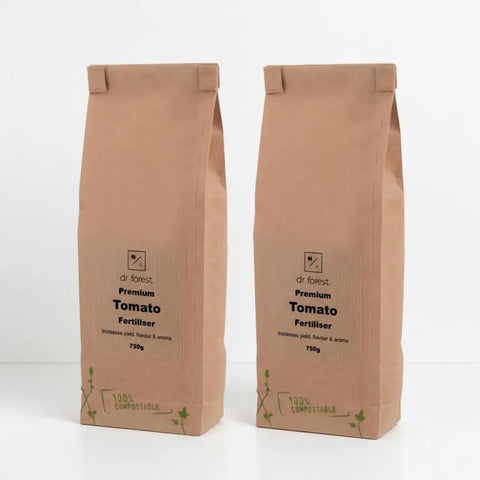
A slow-release 3-4-6 feed for tomatoes.
from £11.50
Customer highlight
Arrived quickly and exactly as described. This is an expensive product for what it does, however, I'm hopeful this will give my organic strawberries a boost in flavour, yield and growth.
Editorial highlight from marketplace and store reviews — separate from the full review list below.
Dr Forest strawberry fertiliser is a slow-release, high-potash strawberry feed with an NPK of 3-2-7, blended from 19 organic and mineral ingredients. Potassium runs at more than twice the nitrogen because a strawberry plant short of potassium gives poorly coloured, pulpy fruit, while too much nitrogen gives you leaf and lowers the sugars. It is mixed by hand in small batches in Stockport and carries 7.2% calcium and 2.5% magnesium alongside the NPK. Every ingredient is named on the next tab.
It is a fertiliser for strawberry plants wherever they grow, from hanging baskets and planters to allotment rows, scattered every 4–6 weeks rather than poured weekly from a watering can. Seaweed, biochar, humic acids and EM-1 microbes look after the soil around the shallow roots.
Every batch is blended by hand at our workshop in Stockport, Greater Manchester, and packed in compostable kraft bags. Dr Forest is named after Joe's grandfather, Dr Forrest, a GP in a Lancashire mining town near Preston who kept a back-garden plot for the runner beans he turned into piccalilli for family and friends. The potash backbone of this feed is Yorkshire polyhalite; here is why we use it. Made by Growers. Backed by Science.
A multi-input blend, with every ingredient listed. Yorkshire polyhalite is the largest at 21% of the blend, and alfalfa meal, at 10%, is one of the largest. The label on each card is the job that ingredient does.
21% of the blend. One low-chloride mineral carrying 14% K₂O, 17% CaO, 6% MgO and 48% SO₃, mined 1,200m below the North Sea. We also sell polyhalite on its own.
The main nitrogen carrier, a plant protein concentrate at 12% nitrogen, released by soil microbes over several weeks.
10% of the blend. Around 2.5% nitrogen, trace minerals and triacontanol, a leaf-wax compound that raised fruit sugars when sprayed on strawberries (Pang et al., 2020). More on alfalfa meal as a fertiliser.
23% calcium and 18.6% sulphur as sulphate, available once watered in. Gypsum adds calcium without raising soil pH.
50% K₂O and low in chloride: the quick potassium in the mix. Strawberry is one of the most salt-sensitive crops (Sun et al., 2015), so there is no muriate of potash (potassium chloride) in this blend.
The fastest magnesium source in the blend. Magnesium sits at the centre of every chlorophyll molecule; polyhalite adds a second supply.
A calcined plant meal with around 15% P₂O₅ and 9% CaO, released within weeks for rooting and flower formation.
Trace elements plus the compounds that make seaweed a biostimulant: small amounts of plant hormones, betaines and seaweed polysaccharides (Ali et al., 2021).
2% of the blend. Porous, stable carbon that gives microbes somewhere to live; across 61 studies, biochar raised soil microbial biomass by 26.5% (Kerner et al., 2023).
31% P₂O₅ with a high calcium share. It dissolves slowly, so it is still working when everbearers are setting fruit in August and September.
Humic substances that hold micronutrients in forms roots can take up (Ampong et al., 2022). Fulvic acid is the smaller, more soluble fraction.
Another slow nitrogen source, and food for the soil microbes that break it down.
Droppings, shed skins and feed residue from mealworm rearing. In a pot trial it matched mineral NPK for plant growth and raised soil microbial activity (Houben et al., 2020).
Clays that hold potassium, calcium and magnesium and release them between waterings; useful in light soils and pots.
The soluble part of seaweed, quicker-acting than the meal. Strawberry plants given seaweed extract have produced fruit with more sucrose and fructose (Ali et al., 2021).
Ground basalt that releases iron, manganese, zinc, copper and silicon as it weathers; see the rock dust guide.
Lactic acid bacteria, yeasts and other beneficial microbes that get the meals and minerals breaking down. We also sell EM-1 on its own.
Silicon is taken up as silicic acid and laid down as silica in cell walls. It is not an essential nutrient, but it helps plants under drought and salt stress (Luyckx et al., 2017).
Comfrey leaf is rich in potassium; the others add plant material for soil life. The evidence for individual herbs is thin, so it is a supporting act.
Apply to the soil surface and incorporate lightly into the top 5–10cm only. Deep incorporation is unnecessary and can damage the shallow fibrous root system. Always leave a 10cm gap from the crown to prevent burn. Water thoroughly after every application.
| Situation | Rate | Method | Notes |
|---|---|---|---|
| Beds and raised beds | 100–170g per m² | Work into top 10–15cm before planting | 100g/m² in fertile soil or for light-feeding alpine types. 130g/m² for average garden soil. 170g/m² for maximum flavour in new beds, or when pushing sweetness and aroma to the peak; this rate gives a strong potassium foundation for the season. |
| Single plants at planting | 15–40g per plant (1–3 tablespoons) | Mix into soil around each crown | Leave a 10cm gap from the crown. 15g for small transplants or alpine types. 25–30g for established crowns. 40g for maximum flavour; this concentrates potassium in the root zone. |
| Containers, pots and hanging baskets | 5–10g per litre of compost | Mix through full volume before planting | 5g/L if using mycorrhizal fungi inoculant (lower P avoids suppressing colonisation). 10g/L in plain compost without mycorrhizal fungi. |
| Situation | Rate | Frequency | Notes |
|---|---|---|---|
| Rows and beds — top-dressing | 80–160g per metre of row | Every 4–6 weeks | 80g/m for maintenance and light-feeding varieties. 120g/m for standard feeding. 160g/m during peak fruiting for maximum sweetness and aroma. Spread evenly along the row, lightly scratch in and water well. Avoid direct contact with crowns. |
| Single plants — top-dressing | 15–40g per plant (1–3 tablespoons) | Every 4–6 weeks | 15g for light feeders. 25–30g for standard feeding. 40g during peak fruiting for maximum flavour. Apply in a ring 10–15cm from the crown, incorporate lightly and water in. |
| Containers and pots — top-dressing | 1–3g per litre of pot volume | Every 4–6 weeks | 1g/L for light feeders and alpine types. 2g/L for standard feeding. 3g/L during peak fruiting for maximum sweetness and aroma; this is the rate that pushes potassium delivery highest. Apply to the compost surface, scratch in lightly and water thoroughly. |
Early spring as growth resumes, or 4–6 weeks after planting once established. Apply every 4–6 weeks during the growing season. Focus on the pre-flowering and fruiting stages for maximum sweetness. Reduce or stop after the main harvest to avoid excess foliage.
Strawberries want a steady supply of potash for sweet, well-coloured berries, and only a modest amount of nitrogen. Too much nitrogen gives big leafy plants, soft fruit and more grey mould. Feed at the key moments rather than all season.
Summer-fruiting (June-bearing) strawberries in the ground
Everbearing (perpetual) strawberries in the ground
Don't go above 200 g per m² in a season, and don't feed after mid-August.
New beds: fork 100–130 g per m² into the soil before planting. Only go up to 170 g per m² if a soil test shows low potash. Summer-fruiting plants then need nothing more until after their first picking.
Pots, troughs and grow bags
Good to know
| When | Feeding |
|---|---|
| Feb–Mar | First feed as new growth appears (100–170g/m² or 15–40g per plant). |
| May | Second feed for June-bearers (80–160g/m of row). |
| June | Feed everbearing and day-neutral varieties every 4 weeks at the lower end. |
| July | Post-harvest feed for June-bearers — critical for next year. |
| August | Final feed for everbearing varieties. Stop feeding June-bearers by late August. |
| Nov–Jan | Plants dormant. No feeding. |
| Type | Rate | Frequency | Key timing |
|---|---|---|---|
| June-bearing | Standard range | Every 4–6 weeks | Pre-flowering and immediately post-harvest; stop by late August |
| Everbearing | Lower end of range | Every 4 weeks | Continuous through season |
| Day-neutral | Lower end of range | Every 4 weeks | Continuous, lighter feeds |
| Alpine | Lowest range | Every 6–8 weeks | Spring and midsummer only |
Containers, hanging baskets and strawberry planters: charge the compost at 5–10g per litre before planting, then feed every 4 weeks at the lower end of the range. After the harvest: for June-bearers, one application immediately after harvest, then stop by late August; for everbearing types, continue feeding through to the final flush, then stop. With mycorrhizal fungi: use the lower compost rate (5g/L) initially to avoid high phosphorus inhibiting colonisation, apply the inoculant directly to the roots at planting, and resume normal rates after 4–6 weeks once the networks have established. The top-dressing guide covers the scratch-in method.
Strawberries prefer slightly acidic soil at pH 5.5–6.5, ideally around 6.2. Test annually, and incorporate any correction 3–12 months before planting.
| To | Material and rate | Time to take effect |
|---|---|---|
| Lower pH | Elemental sulphur at 100–200g/m² | 3–6 months |
| Raise pH | Agricultural lime at 100–300g/m² | 3–12 months |
The calcium from gypsum in this formula does not raise pH. More detail in how to make soil more acidic, or raise the pH.
3 level teaspoons = 1 tablespoon ≈ 15g. We recommend mixing the fertiliser with an equal volume of compost before application: it cuts down dust and coats the granules in microbe-rich compost.
Use Dr Forest Seaweed Powder as a fortnightly foliar spray for a seaweed biostimulant without extra nitrogen. Apply Dr Forest Liquid Gypsum as a root drench every 2–4 weeks for additional calcium. Apply mycorrhizal fungi inoculant at planting for improved nutrient uptake.
Cool, dry place out of direct sunlight. Keep sealed between uses. Effective for at least 18 months.
Strawberries are easy to grow in a British garden and easy to grow badly. The difference is mostly type, site, watering and the age of the plants.
Day-neutral is the American name for everbearing types that flower regardless of day length, such as Albion and San Andreas. Alpines are a separate species with small, aromatic berries and few or no runners.
One concentrated flush over 2–4 weeks in June–July. Feed in early spring as growth resumes, again just before flowering, and once more immediately after harvest to build reserves for next year's crowns. Stop feeding by late August. The post-harvest feed is as important as the pre-flowering one: it carries the plant into autumn, when next year's flower buds form.
Multiple flushes from June through to October. Lighter, more frequent feeding keeps potassium supply steady without nitrogen spikes between flushes.
These fruit continuously regardless of day length. Manage them like everbearers but with even lighter individual applications. Watch for lush foliage and adjust downward; they are sensitive to excess nitrogen.
Small, intensely flavoured berries on plants that need minimal feeding. Overfeed and you lose the intensity. Mara des Bois is technically a day-neutral but grows like an alpine, so feed it as an alpine.
Swelling berries are mostly water. Keep the soil evenly moist from flowering to the last pick, and water the soil rather than the plant; berries that sit wet in still air are the ones that rot.
Check daily from flowering; water until it runs from the base. If dry compost sheds water, see why pots and baskets stop taking water.
A deep morning soak two or three times a week in dry weather; a seep hose under the straw keeps the fruit dry.
Plants dry out faster and fruit earlier; start daily checks sooner, and open doors on warm days for air and bees.
Calcium reaches the fruit in the water flowing through the plant, mostly around fruit set (Hocking et al., 2016), so a dry spell at flowering costs the berries calcium whatever the soil holds.
| Month | Task | Feeding |
|---|---|---|
| Feb–Mar | Clear dead leaves. Move pots under cover for an early crop. | First feed as new growth appears (100–170g/m² or 15–40g per plant) |
| April | Flowering begins. Fleece on frosty nights. Remove runners. | — |
| May | Fruit sets. Tuck straw under developing fruit. | Second feed for June-bearers (80–160g/m of row) |
| June | Main harvest for June-bearers; pick every day or two. | Feed everbearing and day-neutral varieties every 4 weeks at the lower end |
| July | Renovate June-bearers. Let chosen runners root. | Post-harvest feed for June-bearers — critical for next year |
| August | Sever rooted runners; pot up or plant out. | Final feed for everbearing varieties. Stop feeding June-bearers by late August |
| Sep–Oct | Plant new runners into a prepared bed. | — |
| Nov–Jan | Plants dormant. Protect containers from hard frost. | No feeding |
Full sun counts most; water evenly and replace old plants. Flavour also dips late in a picking season, when falling sugars take aroma with them (Schwieterman et al., 2014).
Stop any high-nitrogen feeding and remove runners. New plants make leaf first; give them a season.
Frost blackens the centre of the flower, the part that becomes the berry, while the petals look fine; those flowers will not fruit. Fleece on frosty nights in April and May.
Flesh only swells evenly under pollinated seeds. Under cover, let bees in or brush the flowers.
Most common on light, sandy soils and in pots; this feed carries magnesium from Epsom salt and polyhalite. Old leaves also colour naturally in autumn.
A strawberry's flavour comes down to sugars, acids and aroma. When 166 consumers rated fruit from 35 varieties and breeding lines, sweetness and strawberry flavour intensity drove how much they liked it: total sugars explained nearly half the variation, and sourness made no measurable difference (Schwieterman et al., 2014).
Potassium is sometimes called the quality element: it runs enzymes in photosynthesis and regulates the stomata, and without enough of it the plant makes and uses less sugar (Hasanuzzaman et al., 2018). Strawberry plants short of it give shrivelled, poorly coloured, pulpy fruit (Taghavi et al., 2019). Nitrogen cuts both ways: more yield, but lower sugars in one of two varieties in a Florida trial (Agehara, 2021). Hence more than twice as much potassium as nitrogen, with the nitrogen in slow organic forms.
| Compound | Type | What the study found |
|---|---|---|
| Sucrose | Sugar | The single biggest contributor to overall liking |
| Hexyl acetate, hexyl butanoate | Esters (fruity aroma) | Raised perceived sweetness independently of sugar |
| γ-Dodecalactone | Lactone | Raised perceived sweetness independently of sugar |
| 1-Penten-3-one | Ketone | Raised perceived sweetness independently of sugar |
| Acidity (perceived sourness) | Taste | No link with overall liking |
All rows: Schwieterman et al. (2014), 81 volatiles measured.
Sulphate of potash is the fast source. Yorkshire polyhalite adds calcium, magnesium and sulphur with its potassium, and in four UK field trials it matched or beat muriate and sulphate of potash for potassium uptake in three (Lillywhite et al., 2020).
In a two-season Florida trial, extra early nitrogen kept adding yield in 'Florida Radiance' while its early-season soluble solids fell by 0.91 °Brix for every extra kilogram per hectare per day; in 'Florida127' yield peaked at an intermediate rate (Agehara, 2021). Three per cent nitrogen, released slowly, aims for the useful side of that trade.
Calcium barely moves in the phloem, so fruit gets it from the water stream, and most of it arrives early in fruit development, when the young fruit transpires fastest. It cross-links pectin in cell walls (Hocking et al., 2016); in strawberry trials, calcium sprays gave firmer fruit (Taghavi et al., 2019).
Strawberry is one of the most salt-sensitive crops, and leaf chloride above 0.5% is linked to leaf scorch and lost yield (Sun et al., 2015). Muriate of potash is potassium chloride; the two main potash sources in this blend are sulphates.
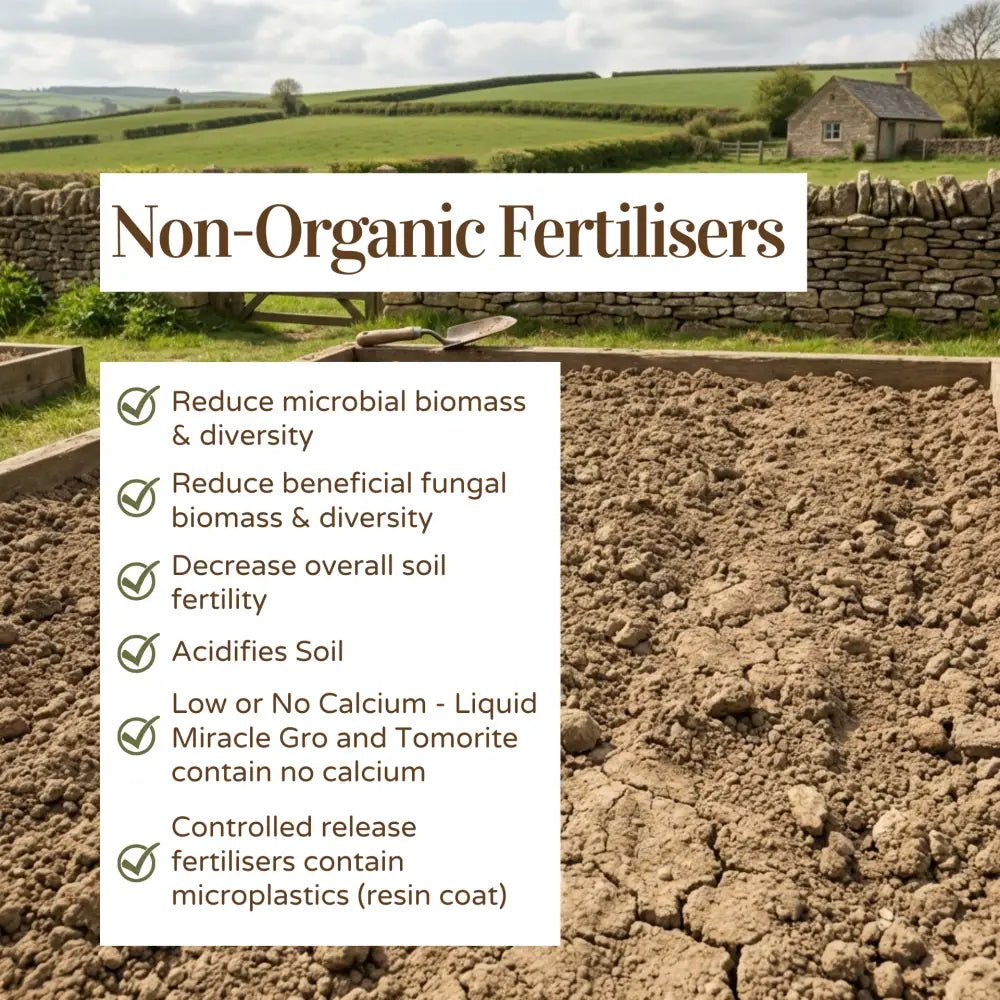
Organic strawberry fields on 13 paired Californian farms held more carbon, nitrogen and microbial biomass than conventional ones (Reganold et al., 2010). Biochar raised microbial biomass by 26.5% across 61 studies (Kerner et al., 2023), and mealworm frass lifted microbial activity most alongside mineral fertiliser (Houben et al., 2020). The evidence for humic acids is mostly from laboratory and pot work, and results are inconsistent (Ampong et al., 2022).
Triacontanol sprayed on strawberries raised sugars and anthocyanins (Pang et al., 2020), as seaweed extract has raised fruit sugars (Ali et al., 2021); a granular feed delivers far less of either, so read that as mechanism, not promise. Silicon is laid down in cell walls, strengthens stems and helps plants under drought and salt stress (Luyckx et al., 2017).
| Study | Scope | Finding |
|---|---|---|
| Reganold et al. (2010) | 13 paired organic and conventional strawberry fields, California | Organic fruit: more antioxidants, vitamin C and dry matter, longer shelf life, but 13.4% smaller. |
| Schwieterman et al. (2014) | 54 samples, 35 varieties and breeding lines, 166 consumers | Sugars explained nearly half of liking; some aroma compounds raised sweetness without extra sugar. |
| Agehara (2021) | Florida field trial, two seasons, two varieties | More early nitrogen raised total-season yields by up to 56–58%; soluble solids fell in one variety. |
| Sun et al. (2015) | Seven varieties under salt stress for four months, greenhouse | Salt cut growth and fruit yield, by up to 56% in two varieties at the highest level; 'Albion', 'Camarosa' and 'San Andreas' coped best. |
Figures describe the published literature on these ingredient classes and are not product-specific yield guarantees.
In winter, and late in the season. From November to January the plants are dormant, so don't feed them at all. Stop feeding June-bearers by late August, after their post-harvest feed in July. Give everbearing varieties their last feed in August. Feeding late pushes soft leaf when the plant should be firming up for winter and setting next year's flower buds.
Not ideal. Strawberries fruit best on more potash than nitrogen, and extra nitrogen tends to give you leaf and softer, less sweet berries. Strawberries are also salt-sensitive, which concentrated soluble feeds don't suit. This feed is 3-2-7, with 7.2% calcium and 2.5% magnesium, and releases slowly over 4–6 weeks.
54% of buyers here also chose Organic Tomato Fertiliser
A slow-release 3-4-6 feed for tomatoes.
from £11.50
A balanced 4-5-6 feed for fruit and veg.
from £11.50
A slow-release feed for a heavier potato crop.
from £11.50


