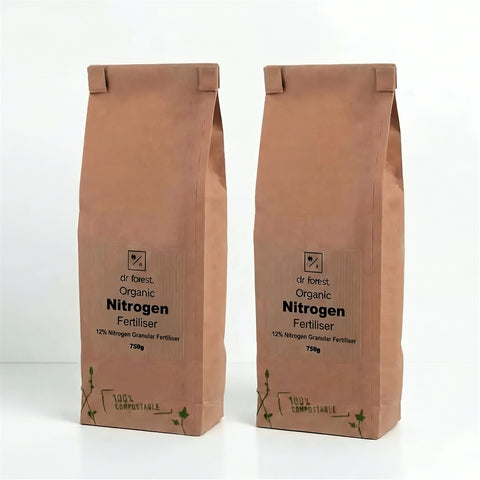
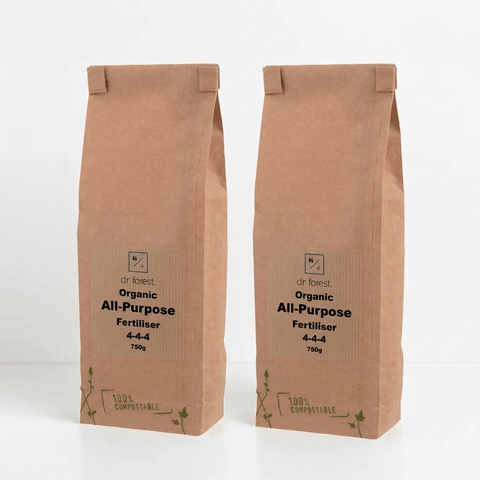
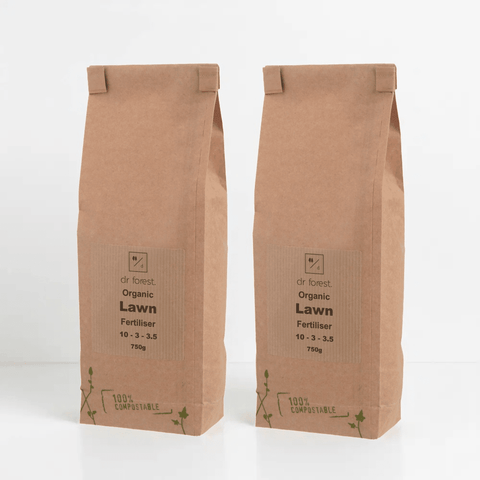
Two bags of Dr Forest Organic Lawn Fertiliser 10-3-3.5 grass feed
Dr Forest Organic Lawn Fertiliser in a British garden with an established lawn
Dr Forest Lawn Fertiliser 10-3-3.5 benefits: nitrogen from plant protein, half ready in two weeks, no weedkiller or moss…
How to use Dr Forest Lawn Fertiliser 10-3-3.5: Spring feed 50-60 g; Summer top-ups 45 g; Tired lawns 60 g
Dr Forest Lawn Fertiliser 10-3-3.5 cost per use by pack size: 1.5 kg 42p per m², 4 kg 32p per m², 9 kg 27p per m², 15 kg…
Dr Forest Lawn Fertiliser 10-3-3.5 compared with liquid 7-2-3: how often, applied, speed
What Dr Forest Lawn Fertiliser 10-3-3.5 works with: scottish seaweed, sulphate of potash, volcanic rock dust
When to use Dr Forest Lawn Fertiliser 10-3-3.5 in the UK, month by month: first feed, second feed, optional top-up, final…
Dr Forest Lawn Fertiliser 10-3-3.5 common questions: Will it burn the lawn? How fast does it work? When should I stop?
A gloved hand holding Dr Forest Organic Lawn Fertiliser granules

Slow-release granules

Lawn Fertiliser 10-3-3.5

£12.65 £8.43 / kg

A high-nitrogen granular lawn feed that greens fast, then keeps feeding for weeks.

  • 45–60 g per m² a feed
  • Feeds for around six weeks
  • Feed only: no weedkiller
Choose a size
Help me choose

1.5 kg covers about 25–33 m² a feed at 45–60 g per m², or about 10 m² for a season of three feeds.

How would you like to buy?
  • Free UK delivery on orders over £40 Otherwise £2.25 under £22, or £3.00 from £22 to £40.
  • Dispatched from Stockport in 1–2 working days.
  • Unopened packs can be returned within 30 days.
  • A feed only: no weedkiller or moss killer. Make the last feed by the end of August, then switch to Sulphate of Potash.

Any 3 small packs, 10% off. Mix and match the smallest size of any product. Here that's the 1.5kg.

Complete the season

  • 4.95/5 from 513 reviews
  • Made in Britain
  • Vegan: no animal products
Lawn Fertiliser 10-3-3.51.5 kg · £12.65

Overview

Greens fast, then keeps feeding for around six weeks.

A high-nitrogen granular lawn fertiliser whose nitrogen is a natural plant protein, not a chemical salt, so it greens grass quickly without scorching it. It feeds the living soil underneath too, and it's made in Britain. Growing notes for 194 plants are in our plant growing directory.

Greens fast, feeds for weeks

Roughly half the nitrogen is ready in the first two weeks. The rest feeds steadily over the following month or so.

No burnt patches

The nitrogen is a gentle, low-salt protein, so it won't burn young grass on new lawns and bare patches.

Feeds the soil, not just the grass

Humic and fulvic acids feed the soil life that passes food to the grass, so a tired lawn slowly comes back to health.

A feed, not a weed-and-feed

There's no weedkiller in the bag, so the clover and daisies the bees visit stay in the lawn.

On the bag

What 10-3-3.5 means

N10%

Nitrogen

Leaf and shoot growth. Too little shows as pale older leaves and slow growth.

P3%

Phosphate

Roots, flowering, and fruit and seed set. Too little shows as stunted plants.

K3.5%

Potash

Water control, flower and fruit quality, and hardiness against drought and cold.

Plus about 9% sulphur, 5.5% calcium and 3% magnesium, typical figures that come with the ingredients: the sulphate of potash brings sulphur, the ground rock a little calcium.

Dose and size finder

How much do I need?

Tell us your lawn's size and condition. You'll get the grams for each feed, the season total and the bag that covers it.

What's your lawn like?

Most lawns: 50–60 g per m² in spring, then 45 g per m² every 6–8 weeks to the end of August. Three feeds a year suits most lawns.

Top-ups after the spring feed
–

–

–

Rates from this page: 45–60 g per m² a feed, every 6–8 weeks from late March to the end of August. Never more than 60 g per m² in one go.

How to use

Mow, spread, water in.

Feed every 6–8 weeks from mid-spring to the end of August. Spread it evenly, in two passes on a small lawn, and water it in unless rain is due.

  1. Mow first

    Cut the lawn a day or two before and clear the clippings, so the granules can reach the soil.

  2. Pick your moment

    Feed when the soil is moist and the grass is growing, ideally with rain due in the next day or two.

  3. Measure it out

    A rounded handful (about 45 g) per m², up to a generous handful (60 g) in spring. Weigh the first few.

  4. Spread it evenly

    Use a spreader on a larger lawn. On a small one, spread half, then go over it again at right angles.

  5. Water it in

    If no rain falls within a day, water the lawn so the granules break down and the food reaches the roots. Where water sits on the surface, a natural wetting agent can help it in.

Most lawns

Spring feed, then top-ups

Rate
50–60 g in spring, then 45 g per m²
Spring feed
50–60 g per m², late March to April
Top-ups
45 g per m², every 6–8 weeks
Last feed
By the end of August
How often
Every 6–8 weeks

Two feeds is plenty for an easy, healthy lawn, three suits most lawns, and four is for a showpiece or a lawn that takes a lot of wear.
Fine, well-kept lawns

The lighter end of the rate

Rate
45–50 g in spring, then 45 g per m²
Spring feed
45–50 g per m²
Top-ups
45 g per m², every 6–8 weeks
How often
Every 6–8 weeks

Fine, well-kept lawns. Stick to the lighter 45 g rate throughout and you'll use a little less feed.

Tired or worn lawns

Rebuild the soil underneath

Rate
60 g in spring, 45 g in midsummer
First
Rake out dead moss and matted grass
Then
Spike the lawn all over with a fork
Midsummer
A 45 g per m² top-up
How often
Once, in midsummer

Tired, worn or patchy lawns. Over a season this rebuilds the soil under a worn lawn rather than just colouring the top.

New lawns and bare patches

Once, at sowing or turfing

Rate
About 45 g per m², once
How often
Once, before you sow or turf

The gentle, low-salt protein nitrogen won't burn young, tender grass the way a chemical feed can.

Measuring by hand

Handfuls per m²

Level handful
About 30–40 g
Rounded handful
About 45 g: a routine feed per m²
Generous handful
About 55–60 g: the spring feed

Weighing is always more accurate. Weigh the first few until your eye is in.

When not to feed

Wait for cool, moist weather

Drought
Brown, dry grass you can't water
Cold
Frost about, or frozen ground
Wet
Waterlogged ground
Heat
A heatwave above about 25°C

Feeding grass that is stressed or resting just wastes the feed and can scorch it. Wait until the grass is growing.

A typical UK lawn year

First feed, 50–60 g per m²: March to April
Second feed, 45 g per m²: May to June
Optional top-up if growing well: July to July
Final feed, by end of August: August to August
Switch to a potassium feed: September to October
Rest: don't feed: November to February

Avoid these

Six common mistakes

  • Feeding after AugustLate nitrogen pushes soft growth that winter cold and disease can damage.
  • Feeding stressed or resting grassSkip it in drought, frost, waterlogging or a heatwave above about 25°C.
  • Going over 60 g per m²Never more in one go, and leave at least six weeks between feeds.
  • One heavy pass by handThick spots show as green stripes. Spread half, then again at right angles.
  • Leaving it unwateredThe granules need moisture to start working. Water in if no rain is due.
  • Expecting it to kill weeds or mossIt's a feed only. A thick, well-fed lawn crowds them out over time.

What's in it

Four natural ingredients

Two feed the grass and two look after the soil it grows in. Every one is plant or mineral in origin.

  • Plant protein nitrogen

    From fermented molasses. Roughly half feeds the grass in two weeks, the rest over the next month or so.

    Nitrogen
  • Finely ground natural rock

    Releases phosphate gently for several seasons, and brings a little calcium for strong cells.

    Phosphorus & calcium
  • Sulphate of potash

    Natural, chloride-free potassium for toughness, with sulphur that helps grass use its nitrogen.

    PotassiumSulphur
  • Humic and fulvic acids

    From leonardite, a soft, ancient brown coal. They feed soil life and keep phosphate from locking up.

    Soil life
  • Vegan. No animal products: the nitrogen comes from fermented plant sugars and the rest from natural minerals.
  • Made with organic ingredients. The main feeding parts are approved for organic growing. It isn't certified organic: the leonardite conditioners aren't classed as organic.
  • Safe around children, pets and wildlife. No weedkiller or pesticide. Spread it evenly, water it in and let the lawn dry before anyone plays on it. Store the bag out of reach.

The science

Protein nitrogen: fast colour, less waste.

The nitrogen is a protein that soil life releases gradually, not a salt that dissolves all at once. The grass greens quickly and holds its colour for weeks.

  1. First two weeks

    About half the nitrogen is ready

    Grass takes up the protein nitrogen fast, so you see a green-up quickly, without the scorch of a soluble salt.

  2. The month or so after

    The rest feeds steadily

    Soil life breaks the protein down gradually. Less sits in the soil as loose nitrate, so less washes away after heavy rain.

  3. Around six weeks

    Time for the next feed

    One feed lasts about six weeks, so feed every 6–8 weeks until the end of August. More in our high nitrogen lawn feed guide.

Plants take up organic nitrogen

Plants can take up some nitrogen as whole amino acids, without waiting for it all to turn to nitrate. Loose nitrate washing away after heavy rain is a well-known loss route on turf.

Näsholm et al. (1998), Nature; Näsholm et al. (2009), New Phytologist; Cameron et al. (2013), Annals of Applied Biology.

Humic and fulvic acids feed soil life

They support the soil biology and fine roots that pass food to the grass, and help keep phosphate available instead of locked up in the soil.

Nardi et al. (2002), Soil Biology & Biochemistry; Canellas et al. (2015), Scientia Horticulturae.

Natural feeding builds the soil

Feeding with natural ingredients slowly builds the dark, spongy matter in soil that holds water and roots. In trials it rose by about an eighth compared with chemical feed.

Allam, M. et al. (2022). Agriculture, 12(4), 464.

Figures from published research are not a trial of this product.

Reviews

What growers say

Across the shop: 4.95/5 from 513 reviews.

Read all reviewsHide reviews

FAQ

Questions, answered

19 questions

Still stuck? Get in touch.

What is this lawn feed, in plain terms?

It is a natural, professional-grade, high-nitrogen lawn feed, built to a proper agricultural formula and packed for your lawn. The nitrogen that greens the grass is a natural protein (not a chemical salt), it feeds the roots and toughens the lawn, and it feeds the living soil underneath at the same time. Made with organic ingredients.

Is this a professional-grade product?

Yes. It is professional-grade, agricultural-strength nutrition, packed in a size that suits a garden lawn. It is made to keep grass growing steadily across a whole season, not to look bright on a shop shelf. You are getting the real thing, not a cheaper product designed down to a price.

How fast does it work?

Quickly. Roughly half the nitrogen is ready for the grass within the first two weeks, so you see a green-up fast. The difference from a cheap chemical feed is what happens next: the rest feeds steadily over the following weeks, and because the nitrogen is a natural protein and not a salt, you get that speed without the burn, the quick fade, or the feed washing away in the rain.

Will it burn or scorch my lawn?

It is very unlikely to. Chemical lawn feeds are basically salts, and too much will scorch the grass brown. This feed is not a salt (the nitrogen is a natural protein and the whole blend is low in salt), so it is far gentler. Spread it evenly and water it in if no rain is due, and the grass takes it up steadily.

Does it kill weeds or moss?

No. It is a feed only: there is no weedkiller or moss killer in it. A thick, well-fed lawn does crowd out weeds and moss over time, but if you want to tackle them directly you will need to do that separately.

Is it safe for pets, birds, bees and children?

Yes, used as directed. It is a fertiliser made from natural ingredients, not a pesticide, with no weedkiller in it, so there is nothing in the bag meant to harm birds or bees. As with any garden feed, keep it out of reach of children and pets, spread it evenly and water it in, then let the lawn dry before they go back on it. Once it is watered in, the whole family can enjoy the lawn as normal.

Is it organic?

It is made with organic ingredients: the main feeding parts are approved for organic growing. As a finished product it is not certified organic, partly because it includes the natural soil conditioners from leonardite, which are not classed as organic. If you grow to a certified-organic scheme, it is worth checking the ingredients against your own scheme's rules.

Can I use it on a new lawn or bare patches?

Yes. Because the nitrogen is a gentle, low-salt protein, it will not burn young, tender grass the way a chemical feed can. Rake it lightly into the surface before you sow seed or lay turf.

When in the year should I use it?

Feed from mid-spring (late March to April), once the grass is growing again and the soil has warmed to about 10°C, through to the end of summer. Put down 45 to 60 g per square metre each time, every six to eight weeks. Make the last feed by the end of August (feeding nitrogen later pushes soft growth that winter cold and disease can damage), then switch to a potassium autumn feed, such as sulphate of potash, to toughen the lawn. Don't feed from November to February, while the grass is resting.

What is it actually made from?

Four natural ingredients. The nitrogen is a natural protein made from fermented plant sugars (molasses), the same nitrogen as in our Nitrogen Fertiliser feed. The phosphate that feeds the roots is a soft natural rock, finely ground. The potassium that toughens the grass is sulphate of potash, a natural chloride-free form. And the soil conditioners (humic and fulvic acids from leonardite, a soft ancient brown coal) feed the life in your soil. It is suitable for vegans: there are no animal products in it at all.

Is it granules or powder?

Granules, so it is easy to spread evenly by hand or with a lawn spreader, and it works down to the soil. The granules need moisture to start working, so water it in if no rain is on the way.

How is it different from a supermarket lawn feed?

A cheap lawn feed gives you a fast burst of green from chemical salts that fades in a couple of weeks, adds nothing to the soil, and builds up salt over time. This is professional-grade nutrition: the green comes just as fast, but it lasts, it will not scorch or build up, and it feeds the living soil so the lawn gets healthier year on year rather than just looking green for a fortnight.

Can I use it with other Dr Forest products?

Yes. Scottish Seaweed makes a good spring pick-me-up, and Sulphate of Potash is the natural follow-on in autumn, once you stop feeding nitrogen, to toughen the lawn for winter. On poor or worn ground, Granulated Volcanic Rock Dust puts minerals back into the soil beneath the turf.

How do I store it, and how long does it keep?

Keep the bag closed and dry, somewhere cool and out of reach of children and pets. The granules soak up damp and clump if left open. Kept dry, it lasts for years.

Where is it made?

Made in Britain, blended to a proper agricultural formula and packed under the Dr Forest name.

Is it suitable for vegans?

Yes. There are no animal products in it. The nitrogen is made from fermented plant sugars (molasses) and the other ingredients are natural minerals, so the whole feed is suitable for vegans.

How do I spread it by hand?

Mow a day or two before and clear the clippings. Feed when the soil is moist and the grass is growing. Use a rounded handful (about 45 g) per square metre, or up to a generous handful (60 g) for the spring feed. On a small lawn, spread half the amount, then go over it again at right angles so you don't get green stripes. Water it in, unless rain is due in a day or two.

Granular or liquid lawn feed: which should I use?

This granular feed goes down every six to eight weeks from mid-spring to the end of summer, at 45 to 60 g per square metre, and feeds steadily in between. Our Liquid Lawn Feed 7-2-3 is quicker to take effect but needs feeding every three to four weeks. Pick granules if you want fewer feeds, or liquid if you'd rather use a watering can.

How often should I feed my lawn with it?

Every six to eight weeks, from mid-spring (once the grass is growing and the soil has warmed to about 10°C) to the end of summer. Stop nitrogen feeding after that and switch to Sulphate of Potash in autumn.

Which feed?

Lawn Fertiliser feeds every 6–8 weeks. Here's when another feed suits better.

Liquid Lawn Feed 7-2-3 acts quicker but needs feeding every 3–4 weeks: pick it if you'd rather use a watering can. For a worn lawn on poor ground, Granulated Volcanic Rock Dust puts minerals back into the soil underneath.

You're here
NPK 10-3-3.5

Lawn Fertiliser

Lawns, every 6–8 weeks from mid-spring to the end of August.

Granular · feeds about six weeks

from £12.65

NPK 7-2-3

Liquid Lawn Feed

Pale lawns, fed from a watering can every 3–4 weeks.

Liquid · 50 ml per 4.5 L can

from £13.99View

13% N

High Nitrogen

Leafy crops, brassicas, sweetcorn and lawns: feeds about 6 weeks.

Granular · fast start, slow tail

from £12.99View

NPK 4-4-4

All Purpose

The whole garden: veg, fruit, flowers, shrubs and pots.

Granular · slow, up to 8 weeks

from £12.00View